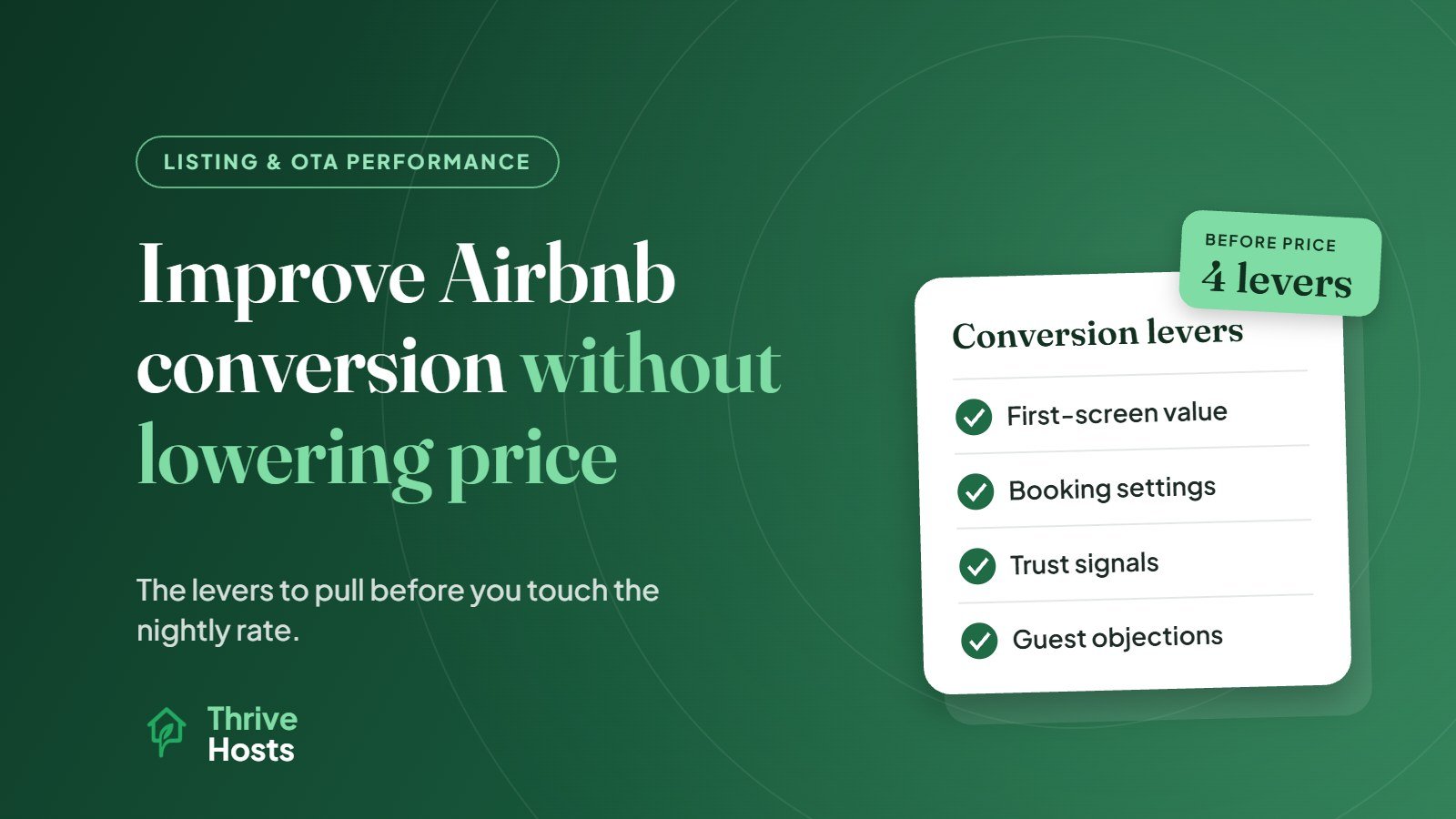
Cutting the nightly rate is the quickest way to push more bookings, but it is rarely the only option and often not the best one. Listing conversion improves when the listing removes doubt and friction for the guests who are already looking. That means making the value obvious, making booking easy, building trust, and answering objections before a guest has to ask.
Price still matters. If you are clearly above comparable listings for the same dates, no amount of better copy will fix it. But if your price is broadly in line and guests are still not booking, there is usually work to do on the listing and its settings first.
Start by Finding Where Conversion Breaks
Before changing anything, look at where guests drop out. Airbnb’s performance dashboard separates conversion into stages: first-page search impressions, search-to-listing conversion (guests who click through to your page), and listing-to-booking conversion (guests who book after viewing). It also shows views, wishlist additions and booking lead time.
This matters because the fixes are different. If guests are not clicking from search, the issue is your cover photo, title or the total price shown in results. If they click but do not book, the issue is on the listing page or in your settings. This article focuses on the second problem, though some levers help both.
Make the Value Obvious on the First Screen
Most guests decide within the first few photos and lines whether to keep reading. Your first five photos, title and the opening of your description should make the main reason to stay clear without scrolling.
If the property’s best feature is a quiet garden, a fast connection and a proper desk, or a five-minute walk to the beach, that should be visible and stated early. A listing that undersells its strengths forces the guest to compare on price alone, which is exactly what you are trying to avoid. Our guides on ordering Airbnb photos and writing an Airbnb title go into more detail.
Remove Friction From the Booking Itself
Settings can quietly stop guests who already want to book. Review each one and ask whether it protects you from a real problem or just creates an obstacle:
- Minimum stay: a three-night minimum might block two-night gaps between bookings and weekend trips that would otherwise convert.
- Advance notice and preparation time: if guests cannot book for tomorrow or the dates next to an existing booking, last-minute demand goes elsewhere.
- Check-in windows: very narrow windows rule out guests arriving on late flights.
- Instant Book: many guests prefer to book immediately rather than send a request and wait. If you require requests, make sure you respond fast.
- Trip length limits: maximum stays set too low can turn away longer, higher-value bookings.
Small changes here often have a bigger effect than a price change, because they open dates and guest types that were previously excluded.
Build Trust With the Details Guests Check
Guests booking a stranger’s home look for signs that the stay will go smoothly. Recent reviews do most of that work, so read them as a guest would. If two of the last five mention a slow check-in or a dirty bathroom, guests will notice even if your average rating is high. Fix the underlying issue first, then respond to the reviews calmly so future guests can see it was addressed.
Your host profile, response speed and the accuracy of your listing all feed into trust as well. A complete profile, quick replies to pre-booking questions and a description that matches the photos make the guest’s decision feel lower risk.
Answer Objections Before They Are Asked
Every unanswered question is a reason to keep browsing. Think about what makes guests hesitate for your type of property and answer it directly in the listing: parking and how far it is, stairs and lifts, noise from the street or nearby bars, how check-in works, Wi-Fi speed, whether the kitchen is equipped for real cooking, and what the bed setup is in each room.
Your guest messages are the best source for this. If the same question comes up three times a month, it belongs in the listing.
Add Value Instead of Cutting the Rate
When you want to make the offer more attractive, there are alternatives to a lower nightly price. Accurate, well-presented amenities matter, especially the ones guests filter for; see which Airbnb amenities matter most to guests. Flexibility can be valuable too: a more flexible cancellation policy, an early check-in or late checkout when the calendar allows it, or a weekly discount that targets the longer stays you want rather than cutting price on every date.
It is also worth checking what guests actually see. Airbnb has shown guests the total price of a stay by default worldwide since April 2025, covering fees before taxes. A large cleaning fee on a short stay can make the total look expensive even when the nightly rate is competitive, so review how your fees combine for the stay lengths you most often get.
Change One Thing at a Time
Conversion work is easiest to learn from when changes are made in sequence. Adjust settings first, then the first screen of the listing, then trust and objections, leaving each change for a few weeks and comparing conversion with the previous period. If a listing still converts poorly after that, price becomes the obvious next lever, and you will at least know it was the real constraint.
If you are not sure whether your problem is visibility or conversion, start with our guide to why your Airbnb listing is not getting bookings.
Getting Help With Listing Performance
Thrive Hosts provides listing management and optimization as part of remote Airbnb co-hosting: photo order, copy, settings, pricing and calendar oversight, review follow-up and guest communication. We look at the whole booking journey, not only the nightly rate.
You keep your listing and accounts. We help make sure the guests who are already looking have fewer reasons to leave.
Get your Airbnb listing reviewed
We will look at where guests are dropping out of your booking journey and which changes are worth making before you touch your price.
Get Your Airbnb Listing Reviewed
Bruce J is the CEO of Thrive Hosts and leads the short-term rental team. He works on the operations and performance side of STR: guest communication, pricing and calendar discipline, turnovers, issue tracking and owner reporting across Airbnb, Vrbo and Booking.com. On the blog he writes practical, no-fluff guides for owners and operators who want their rentals to run more consistently.