A good Airbnb title does one job: it gives the right guest a specific reason to open your listing instead of the one next to it. It is not a description and it is not a keyword list. It is a short, scannable hook that sits next to your first photo in search results, and in most cases the photo is doing more of the work. The title’s role is to confirm and sharpen what the photo suggests.
That means the best titles are specific, short and honest. Here is how to write one.
Once you have a draft, run it through the free Airbnb title checker, or start from scratch with the rule-based title generator.
Keep It Under 50 Characters
Airbnb’s own guidance on listing titles recommends staying under 50 characters, because longer titles get cut off in search results on smaller screens. Most guests browse on a phone, so the part after the cut-off often goes unread.
In practice this forces a useful discipline. You have room for one main idea and possibly a second supporting detail. If your title currently tries to mention the view, the hot tub, the location, the parking and the workspace, it is trying to do the description’s job.
Do Not Repeat What Search Already Shows
Guests already see key details in search results, such as the location and the number of beds, and Airbnb notes there is generally no need to repeat information that is shown automatically. “2BR apartment in Lisbon” spends most of your characters on facts the guest can already see.
Use those characters on something only your listing can say instead. The question to ask is: what would make someone scrolling past twenty similar listings stop on this one?
Lead With Your Strongest Differentiator
Every property has one or two features that matter most to the guests who book it. For a mountain cabin it might be the hot tub or the view. For a city apartment it might be walkability to a specific area, a quiet street, or free parking where parking is scarce. For a family home it might be a fenced garden or a games room.
Put that feature first. Compare these two titles for the same property:
- “Cozy and modern apartment with everything you need”
- “Canal-view loft, 5 min walk to the old town”
The first could describe thousands of listings. The second tells a guest exactly what they get and who it suits. Specific details read as more credible than adjectives like cozy, stunning or perfect, which guests have learned to skip.
Write for the Guest You Actually Want
Titles work best when they speak to one type of traveler. A property that mostly books business travelers on weekdays should not lead with “perfect for family getaways.” Look at your recent bookings and reviews. Who stays, why did they choose you, and what do they mention afterwards? Those words often make the best title material.
Some useful angles by guest type:
- Remote workers: dedicated desk, fast Wi-Fi, quiet location.
- Families: garden, cot or high chair, space to spread out, near a park or beach.
- Couples: view, hot tub, fireplace, privacy.
- Groups: separate bedrooms, large kitchen or outdoor space, parking for several cars.
Follow the Formatting Basics
Airbnb’s guidelines recommend sentence case, which means capitalizing only the first word and proper nouns, because it is easier to read than title case or all caps. Avoid emojis and decorative symbols, which can make the title harder for some guests to read and can look spammy. Separate ideas with a comma or a slash rather than a row of dashes or stars.
And keep it accurate. If the title promises a sea view, the photos need to show it clearly and the guest needs to see it from the property. An exaggerated title might win a click, but it tends to cost you later in reviews about accuracy, which hurts far more than a slightly less exciting headline.
Make the Title and First Photo Agree
Guests read the title and the cover photo together. If the title highlights the rooftop terrace and the first photo is a bedroom, the listing sends mixed signals. The strongest search results have a cover image and a title that point at the same reason to book. When you change one, check the other.
Change One Thing and Watch the Results
Rewriting your title is one of the quickest changes you can make, which makes it tempting to keep changing it. Resist that. If you change the title, the cover photo and the price in the same week, you will not know which change made the difference.
Change the title on its own, leave it in place for a few weeks, and compare listing views and bookings with the previous period, keeping seasonality in mind. If you have several similar listings, you can compare approaches across them. Small, deliberate changes give you information you can actually use.
A Quick Title Checklist
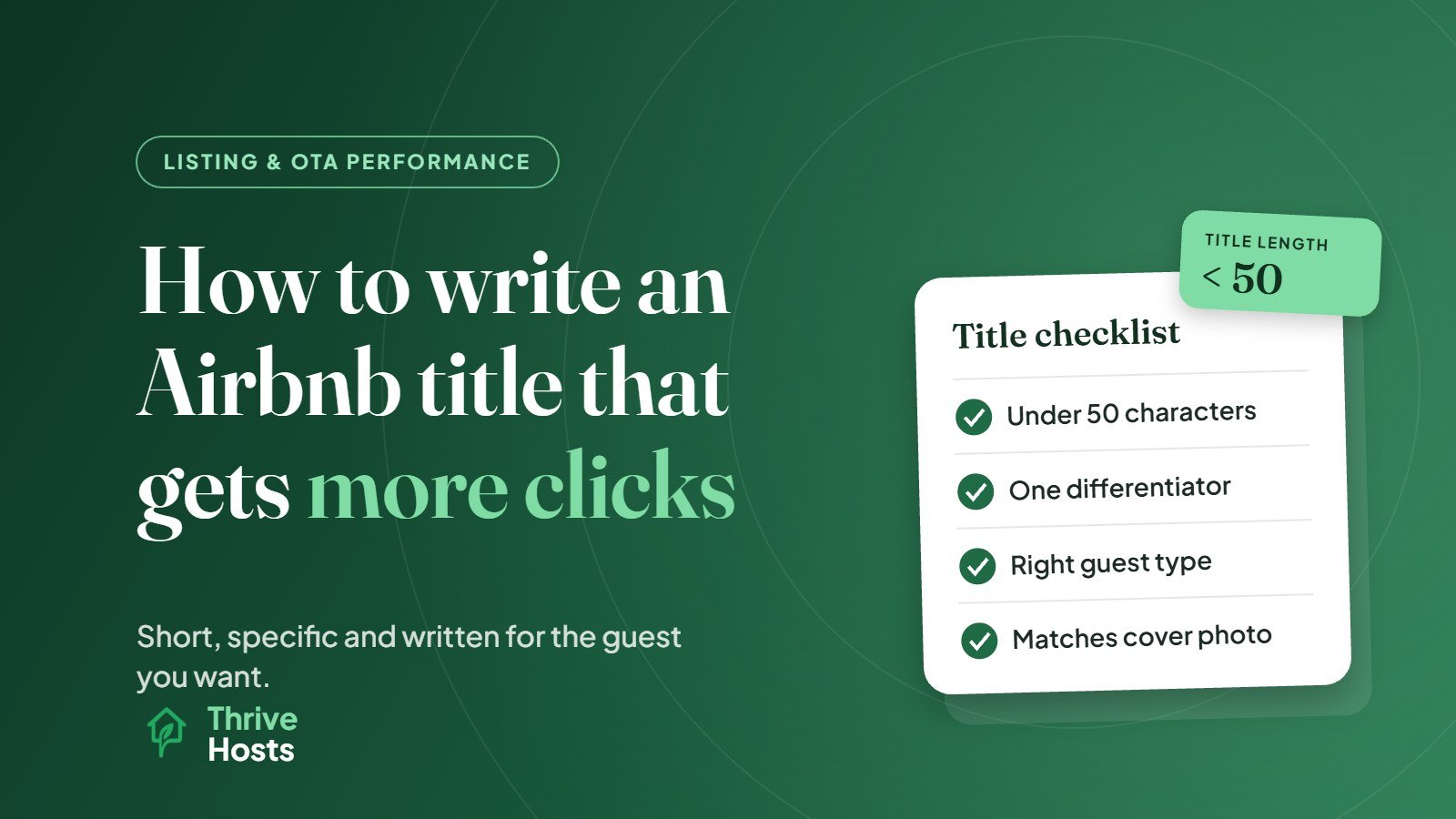
- Under 50 characters, with the most important words first.
- One clear differentiator, stated specifically.
- No repetition of location or bed count already shown in search.
- Sentence case, no emojis, no repeated symbols.
- Written for your most common guest type.
- Fully accurate and supported by your photos.
When the Title Is Not the Real Problem
A better title can help the right guests notice your listing, but it cannot fix pricing that is out of step with the market, calendar rules that block bookings or reviews that raise doubts. If views are fine but bookings are not, our guide to why an Airbnb listing is not getting bookings walks through the full funnel.
Thrive Hosts offers listing management as part of remote Airbnb co-hosting and operations support, including titles, photo order, descriptions, pricing and calendar settings across Airbnb, Vrbo and Booking.com. You keep your listing and accounts; we keep them current and working.
Get your Airbnb listing reviewed
We will look at your title, cover photo and listing setup and point out where guests may be losing interest before they ever open it.
Get Your Airbnb Listing Reviewed
Bruce J is the CEO of Thrive Hosts and leads the short-term rental team. He works on the operations and performance side of STR: guest communication, pricing and calendar discipline, turnovers, issue tracking and owner reporting across Airbnb, Vrbo and Booking.com. On the blog he writes practical, no-fluff guides for owners and operators who want their rentals to run more consistently.