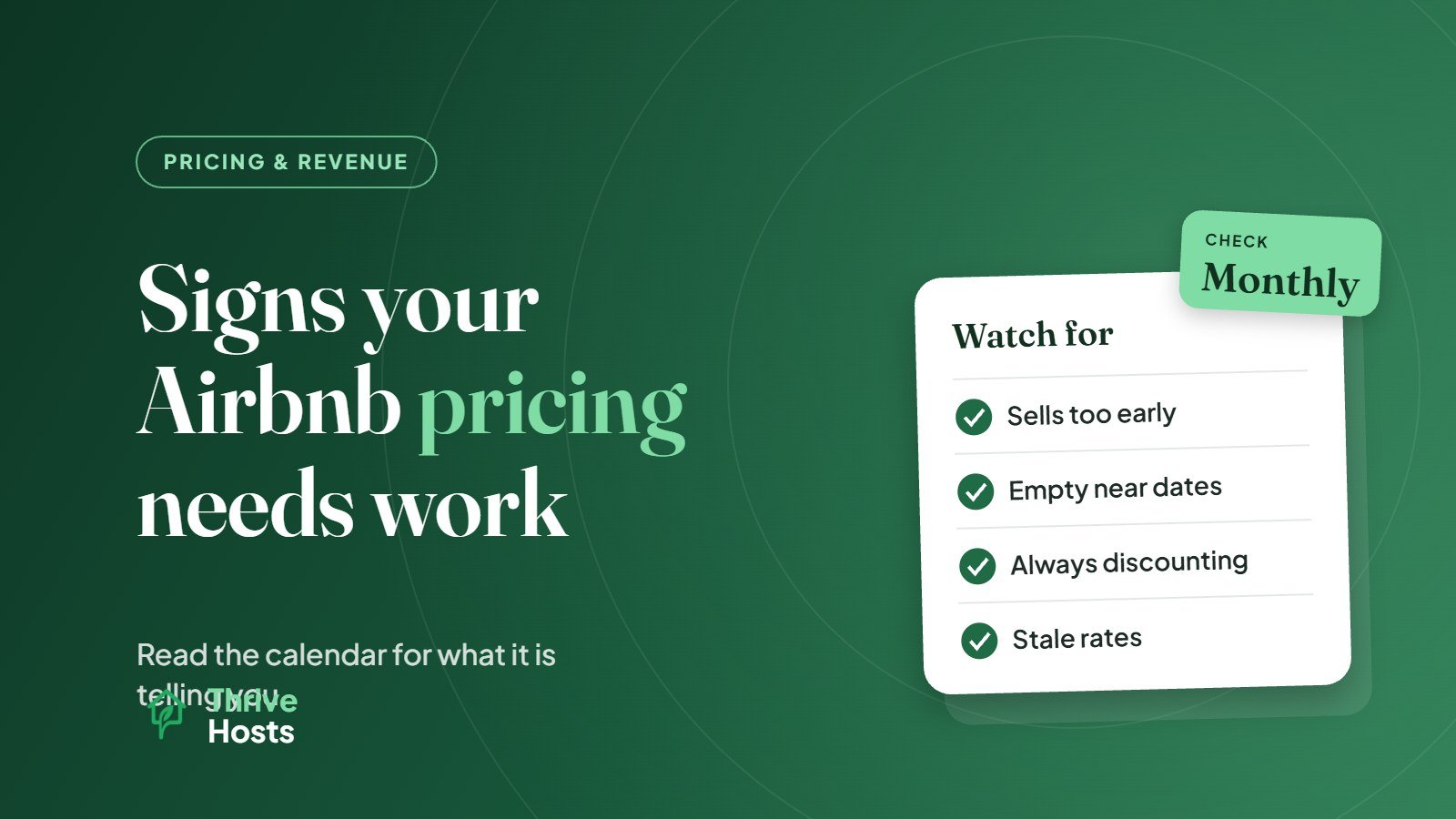
Your Airbnb pricing strategy probably needs work if your dates consistently sell too early or not at all, if most bookings only arrive after a discount, if your prices have not changed in months, or if your revenue is flat while the market around you is moving. Pricing problems rarely announce themselves directly. They show up as patterns in your calendar and booking data, and each pattern usually points to a specific cause.
Here are the most common warning signs and what they tend to mean.
1. Dates sell out far in advance
If peak weekends, holidays and event dates are booked months ahead, and your calendar fills faster than comparable listings, your prices are probably too low for those dates. Early bookings are not bad in themselves, but when nearly everything sells early, it usually means guests see your listing as unusually good value. Our article on why high occupancy does not always mean higher revenue looks at this in more detail.
2. Dates stay empty close to arrival
The opposite pattern, where upcoming dates remain unbooked while similar listings fill, suggests your price is above what guests will pay for those dates. It can also point to a listing or visibility issue rather than price alone. If you are getting views but few bookings, our guide on why guests view your Airbnb but don’t book can help you separate the two.
3. You are always discounting
If most of your bookings only arrive after a last-minute discount, a promotion or a special offer, your base price is likely set too high. Discounting should fill the occasional slow night, not carry your whole calendar. See our guide on when last-minute discounts make sense.
4. Your prices have not changed in months
Static prices are one of the most common problems. Demand changes by season, day of week, lead time and local events. A rate that was right in summer is unlikely to be right in November. If you cannot remember the last time you reviewed your pricing, it is almost certainly out of date. Our guide on how often to change Airbnb prices covers a sensible review rhythm.
5. Weekends and weekdays are priced the same
In most markets, demand differs across the week. If every night has the same price, you may be underpricing your strongest nights and overpricing your weakest. Our article on pricing weekdays vs weekends explains how to set the difference.
6. Events come and go without price changes
If a major local event happens and your rate for that weekend was the same as any other, you likely missed one of the best revenue opportunities of the year. Our guide to how local events should affect Airbnb pricing covers planning ahead.
7. Your calendar has frequent gap nights
Regular one- or two-night gaps between bookings usually come from minimum stay rules that do not match how guests book. They are a calendar strategy issue as much as a pricing one. See how to handle gap nights on Airbnb and our guide to minimum stay strategy.
8. Your pricing tool is running without supervision
Dynamic pricing tools are useful, but they are only as good as their settings. If your minimum price is set too low, your base price is out of date or event overrides are missing, the tool will make poor decisions consistently. Someone needs to review the settings and the results. Our comparison of dynamic vs manual pricing covers where each approach needs human input.
9. Revenue is flat while costs rise
If your nightly rates have stayed level while cleaning, supplies, utilities and platform fees have increased, your margin is shrinking even if occupancy looks healthy. Review your average daily rate and net revenue after costs, not just bookings.
10. You cannot explain your prices
A simple test: can you explain why a given night is priced the way it is? If the answer is “that is what it was set to”, rather than a reason based on demand, season or comparable listings, your strategy is likely running on habit.
What to do next
Start by identifying which of these signs apply. Most properties have two or three, and they often share a root cause, such as an outdated base price or rigid minimum stays. Fix the biggest issue first, give it a few weeks and review the results. For a framework that connects all of these, see Airbnb pricing strategy for hosts.
Recognize a few of these signs?
Thrive Hosts reviews and manages Airbnb pricing remotely, from base rates and seasonal pricing to stay rules, discounts and dynamic pricing settings. We look at what your calendar data is saying and help you act on it, while you keep control of your rates.
Explore Pricing & Revenue Support
Bruce J is the CEO of Thrive Hosts and leads the short-term rental team. He works on the operations and performance side of STR: guest communication, pricing and calendar discipline, turnovers, issue tracking and owner reporting across Airbnb, Vrbo and Booking.com. On the blog he writes practical, no-fluff guides for owners and operators who want their rentals to run more consistently.