Break-even occupancy is the share of available nights you must sell before the property stops losing money. It is one of the most useful numbers an owner can know, and one of the least often calculated. Without it, a 55% occupancy month can feel like a success or a failure depending on mood, rather than on whether the property actually covered its costs.
The idea in plain terms
Every property has costs that arrive whether or not anyone stays, such as the mortgage or rent, utilities, internet, insurance and software. It also has costs that appear with each booking, including cleaning, laundry, supplies and platform fees. Break-even occupancy asks how many nights must be booked, at your usual average rate, for the money coming in to match the money going out.
A simple formula
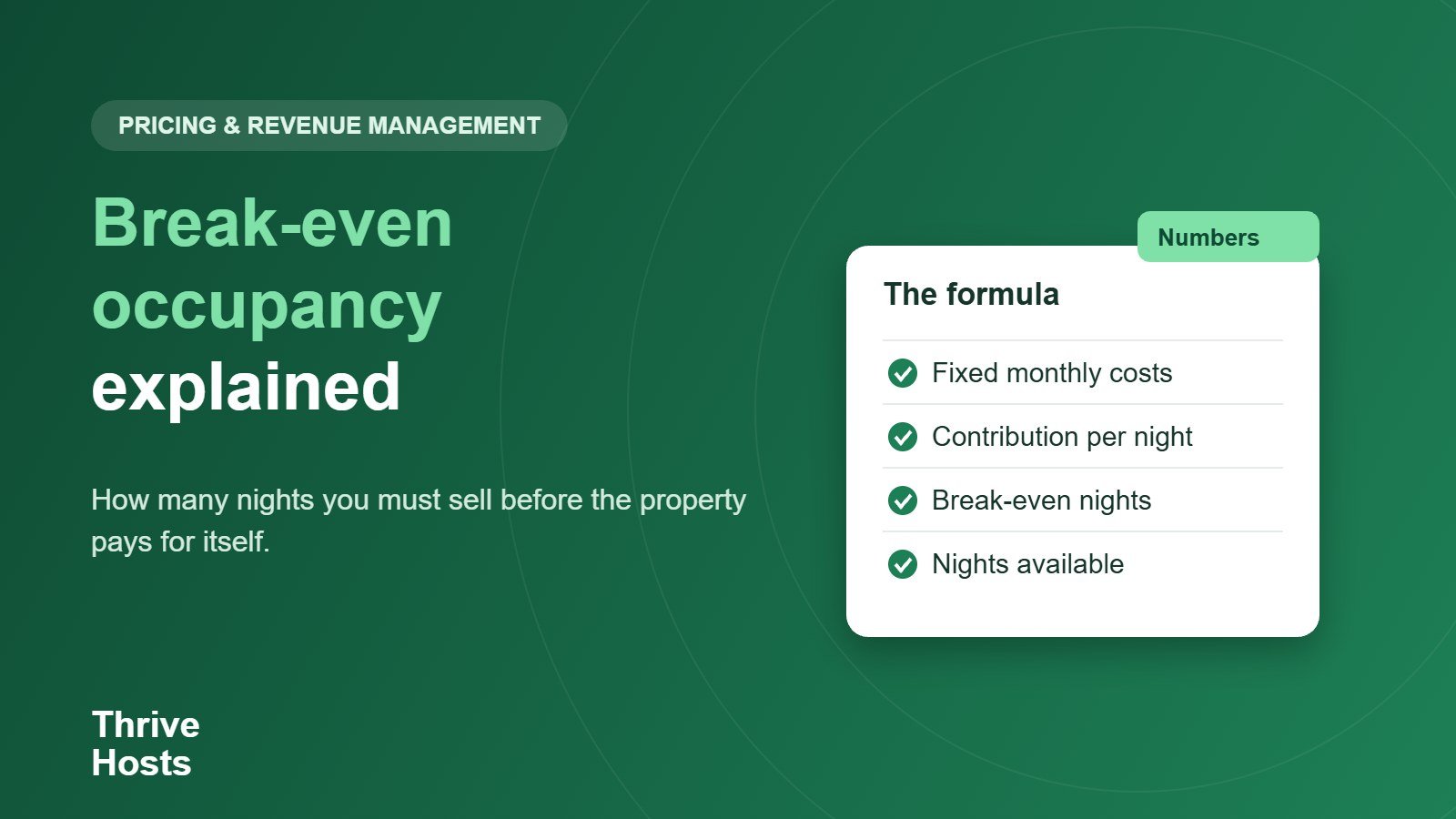
Work with a month, since most costs are monthly. Add up your fixed costs, then work out what each sold night contributes after the costs that vary with each booking.
- Fixed costs for the month: mortgage or rent, utilities, internet, insurance, software and any retainer.
- Average rate per booked night (ADR) after discounts, plus cleaning fees you collect per night on average.
- Variable costs per booked night: platform fee, cleaning and laundry cost, supplies and any per-booking management fee, averaged per night.
- Contribution per booked night: ADR plus cleaning income minus variable costs.
- Break-even nights: fixed costs divided by contribution per night.
- Break-even occupancy: break-even nights divided by the nights available in the month.
The STR profitability calculator works through these steps and lets you try different rates.
A worked example
As an illustration only, suppose fixed costs are 1,800 a month and the average rate is 160. Airbnb’s Help Center describes a 15.5% host fee in 2026, so assume about 25 goes to fees. Cleaning and laundry cost 90 per stay, but the guest pays a 90 cleaning fee, so they cancel out. Contribution is about 135 per night. Break-even is 1,800 divided by 135, roughly 13.3 nights, which is about 44% of a 30-night month. Reaching 44% means you cover costs. Anything above it contributes to profit.
Change one number and the answer moves. If the average rate drops to 130 in a quiet month, contribution falls to about 108 and break-even rises to about 17 nights, or 56%. That is why break-even should be calculated by season, not once a year.
How to use it
Compare break-even with your actual and expected occupancy. If you regularly sit near or below it, you have three levers: raise the average rate, lower costs or increase bookings. Each has limits, and the answer is usually a mix. Our article on high occupancy and low revenue explains why chasing occupancy alone can make the problem worse. You can check your own occupancy with the occupancy rate calculator and read occupancy versus ADR for the balance between the two.
Watch what you leave out
Common omissions are property taxes, repairs and replacement, furniture wear, local occupancy or tourist taxes if you pay them from revenue, and your own time. If you pay a co-host a percentage, include it in variable costs. Setting aside a small monthly amount for maintenance makes the number more realistic, and ignoring it flatters the result.
Break-even checklist
- Calculate break-even for each season.
- Use ADR after discounts, not the listed rate.
- Include platform fees, cleaning costs and any management fee.
- Add repairs, taxes and replacement to fixed costs.
- Compare break-even with realistic occupancy, not the best month.
- Recheck whenever costs or rates change.
Want your numbers reviewed regularly?
Thrive Hosts includes performance reporting in its remote operations support, so owners can see occupancy, ADR, costs and break-even trends in one place. See how our Airbnb co-hosting service works for owners who want clearer reporting.
Explore Airbnb co-hosting
Bruce J is the CEO of Thrive Hosts and leads the short-term rental team. He works on the operations and performance side of STR: guest communication, pricing and calendar discipline, turnovers, issue tracking and owner reporting across Airbnb, Vrbo and Booking.com. On the blog he writes practical, no-fluff guides for owners and operators who want their rentals to run more consistently.