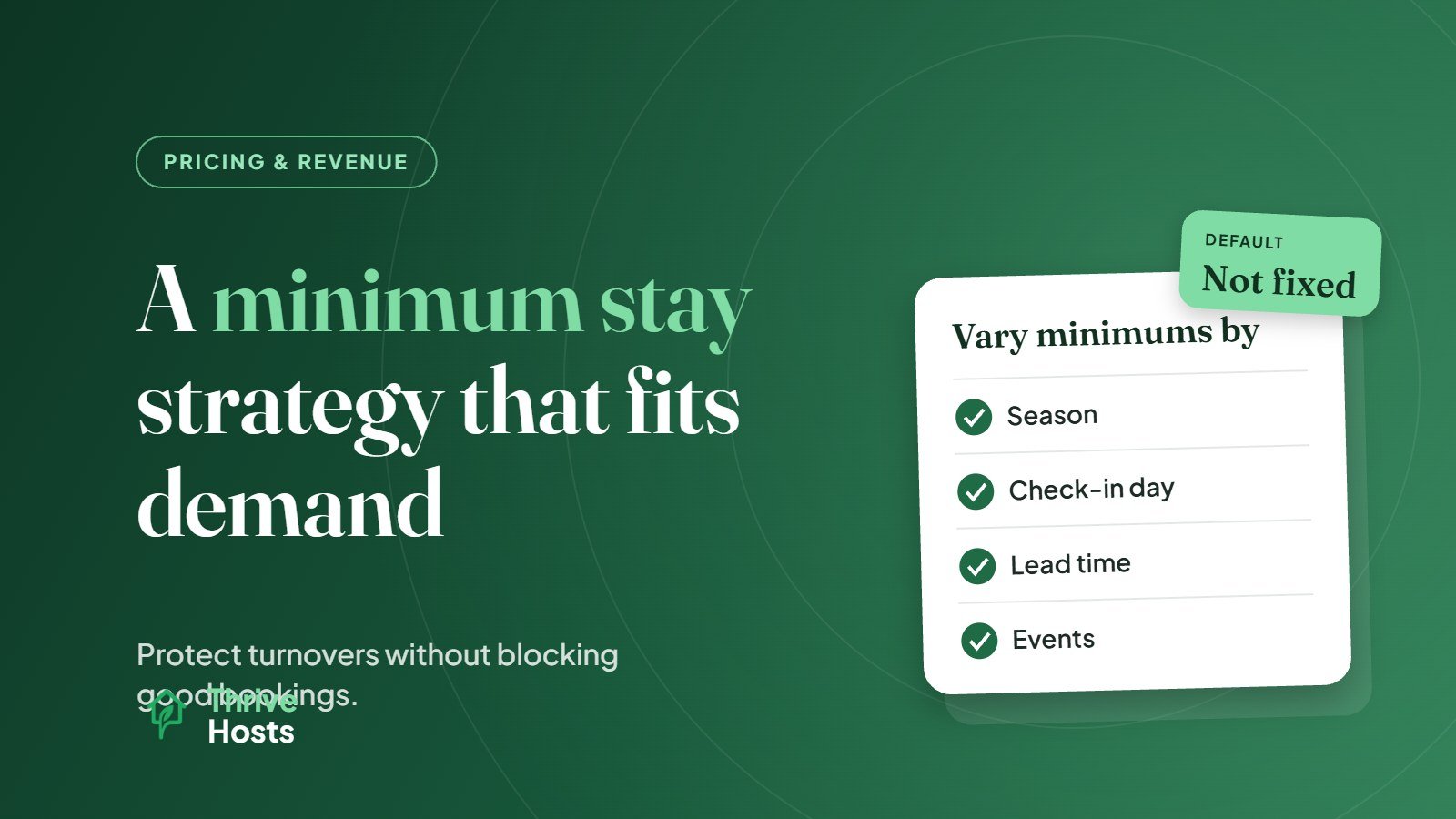
A good minimum stay strategy balances two things: protecting you from short, low-value bookings that cost more in turnovers than they earn, and keeping your calendar open to as many good bookings as possible. The best approach is rarely one fixed number all year. Most well-run short-term rentals use longer minimums in peak periods and far ahead, shorter minimums in low season and close to the date, and specific rules for key check-in days and events.
What a minimum stay actually controls
Your minimum stay determines which searches your listing can appear in. If a guest searches for a two-night stay and your minimum is three nights, your listing is not an option for them. That makes minimum stay one of the most powerful and most overlooked settings in your pricing setup.
The minimum stay calculator compares what 1, 2, 3, 5 and 7-night stays actually earn per night once cleaning and platform fees are counted.
Airbnb’s own guidance on how search results work lists availability, including more flexible stay lengths, among the factors that affect how listings appear. Overly restrictive minimums can therefore narrow your audience in two ways: by excluding shorter trips directly, and by limiting how often your listing is shown.
The case for longer minimums
Longer minimums reduce the number of turnovers. Each turnover involves a cleaning cost, laundry, consumables, guest communication and some wear on the property. For larger homes where cleaning is expensive, or remote properties where cleaners are hard to schedule, a two- or three-night minimum can make sense.
Longer minimums are also useful in peak season and around events, when demand is strong enough that longer stays will fill and you do not need to accept a single night that blocks a better booking.
The case for shorter minimums
Shorter minimums open your listing to more guests: weekenders, business travellers, stopovers and people adding a night to a longer trip. In low season, mid-week, or for dates that are coming up soon, a one- or two-night minimum can turn empty nights into income.
The key check is whether a short stay is worth it after costs. If your nightly rate comfortably covers the turnover cost, one-night stays can add real revenue. If it barely covers the cleaning, they may not.
Vary minimums by season
Your demand changes through the year, and your minimum stay should change with it. A beach house might use a longer minimum in summer, a shorter one in shoulder months and the shortest in winter. A city apartment might keep a short minimum most of the year and raise it around major events. Airbnb’s calendar rule-sets let hosts apply different trip-length rules to selected dates, and most pricing tools offer seasonal minimum stay settings.
Vary minimums by check-in day
Check-in day matters as much as length. A common pattern in leisure markets is a two-night minimum for Friday check-ins to protect the weekend, with a one-night minimum for other days. Airbnb allows hosts to customize minimum nights by check-in day in the trip length settings. This protects your strongest nights without blocking shorter mid-week stays. It also reduces the classic problem of a single Saturday booking leaving Friday stranded.
Vary minimums by lead time
How far ahead a date is matters too. Far in advance, a longer minimum makes sense because there is plenty of time for longer stays to come in. As the date approaches and nights remain open, reducing the minimum widens the pool of potential guests. Many dynamic pricing tools can shorten minimum stays automatically as dates get closer.
Watch for gap nights
Fixed minimums often create gap nights between bookings, short openings that are below your minimum and so cannot be booked. A gap rule that reduces the minimum stay for those specific openings recovers nights that would otherwise be lost. Our guide on handling gap nights on Airbnb explains how to set this up.
Check local rules
Some cities and regions regulate short-term rentals with minimum stay requirements, night caps or registration rules. Your minimum stay strategy needs to work within those rules, so confirm what applies to your property before changing settings.
Review your minimum stay settings regularly
Minimum stays are easy to set once and forget. A quarterly review, alongside your seasonal pricing, is a good habit. Look at how many nights went unbooked because of stay length, how many gap nights appeared and whether short stays are covering their costs. For a broader view of how minimum stays fit with pricing and discounts, see our guide to Airbnb pricing strategy for hosts, and our article on pricing weekdays vs weekends.
Want your stay rules and pricing working together?
Thrive Hosts manages calendars and pricing remotely for STR owners, including minimum stays by season, check-in day and lead time, plus gap night rules. You keep control of the final settings.
Explore Pricing & Revenue Support
Bruce J is the CEO of Thrive Hosts and leads the short-term rental team. He works on the operations and performance side of STR: guest communication, pricing and calendar discipline, turnovers, issue tracking and owner reporting across Airbnb, Vrbo and Booking.com. On the blog he writes practical, no-fluff guides for owners and operators who want their rentals to run more consistently.