The choice is not really between “dynamic” and “manual.” It is between three ways of deciding your nightly rates: letting Airbnb set them with its built-in Smart Pricing, using a third-party dynamic pricing tool, or setting prices yourself. Each can work. They differ in how much time they take, how much control you keep, and how much they depend on someone watching the results.
For most hosts the best answer ends up being a hybrid: automation for the daily adjustments, with a person setting the rules and overriding the dates that matter.
Option 1: Airbnb Smart Pricing
Smart Pricing is Airbnb’s built-in tool. According to Airbnb’s help center, it adjusts nightly prices based on demand within a minimum and maximum you choose. You can override individual nights with custom prices, and you can switch it off at any time without affecting existing reservations.
There are a few details worth knowing before relying on it. Weekly, monthly and trip-length discounts apply on top of Smart Pricing and can take the price a guest pays below your minimum. Smart Pricing also overrides pricing rule-sets, so you cannot use both on the same listing at once. And it only manages your Airbnb price, which matters if you also list on Vrbo or Booking.com.
Works well for: a single Airbnb-only listing, hosts who want a simple starting point, and anyone who will check the minimum price and results regularly.
Watch out for: setting the minimum too low, assuming the tool knows what makes your property special, and leaving it unreviewed for months.
Option 2: A Third-Party Dynamic Pricing Tool
Tools such as PriceLabs, Beyond and Wheelhouse connect to your listings and set prices across several channels. They typically give you more control: base price, minimum and maximum, day-of-week adjustments, lead-time rules, orphan-night handling and minimum-stay logic, along with market data on how comparable listings are pricing and booking.
The trade-off is cost and setup. These tools charge a fee and need configuring properly. Their default settings are a starting point, not a strategy, and a poorly configured tool can be worse than careful manual pricing.
Works well for: hosts on more than one platform, hosts with several properties, and anyone who wants detailed control without changing every date by hand.
Watch out for: treating the tool as set-and-forget, or making so many rule changes that it becomes hard to tell what is working.
Option 3: Manual Pricing
Manual pricing means you decide rates yourself, usually by setting seasonal prices, weekend premiums and event rates, then adjusting dates as they approach. Done well, it can be very effective, especially in small or unusual markets where tools have limited comparable data, or for distinctive properties that do not resemble anything nearby.
The difficulty is consistency. Manual pricing depends on someone reviewing the calendar frequently: spotting unbooked dates early enough to act, raising rates when a weekend fills quickly across the market, and catching local events before they are fully booked. When the person doing it gets busy, prices go stale.
Works well for: experienced hosts with one or two properties who know their market and have time to review prices every week.
Watch out for: prices that drift out of date, missed events, and slow reactions to demand changes.
How the Options Compare
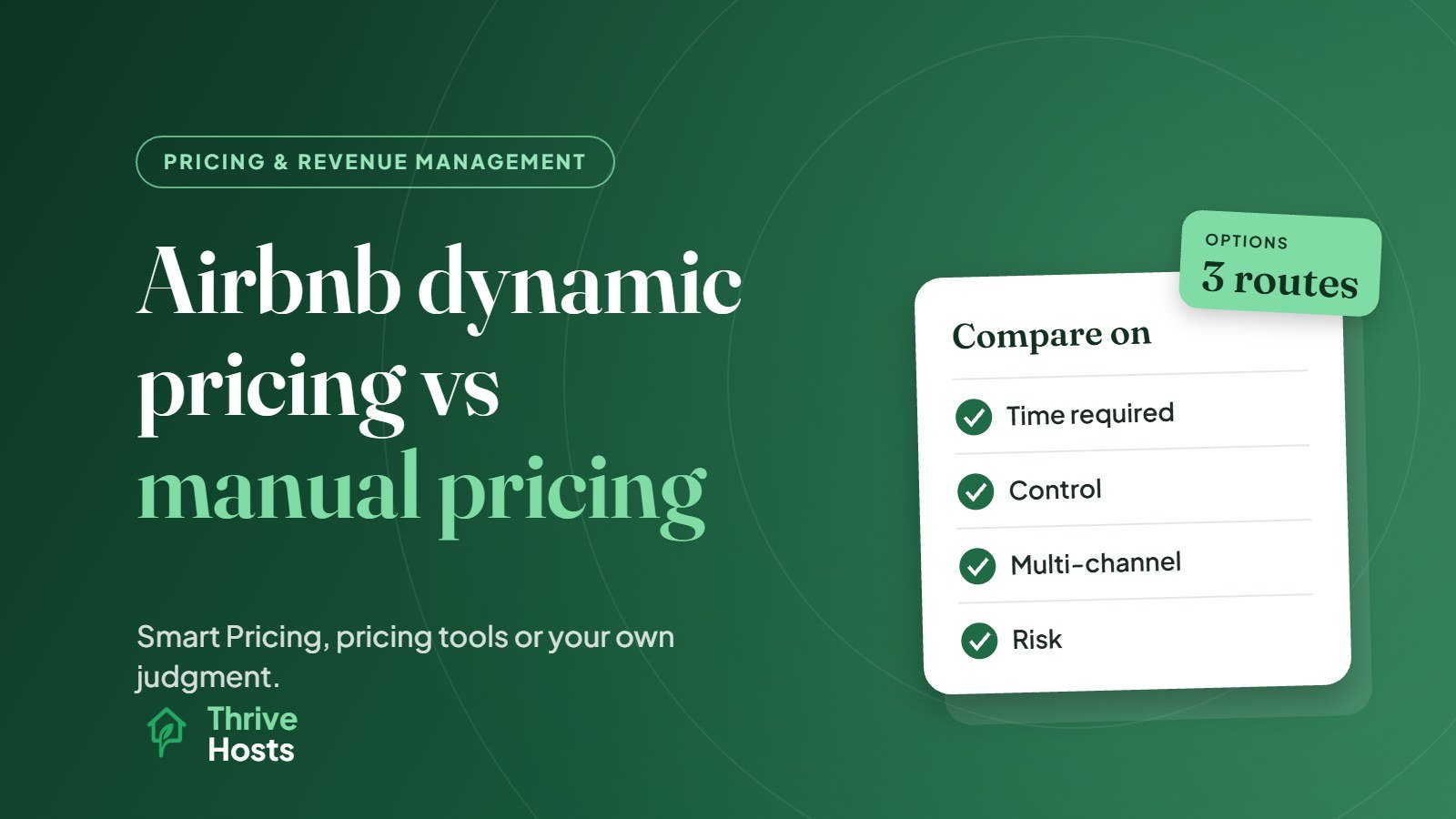
The differences come down to a few practical questions:
- Time required: Smart Pricing needs the least, a third-party tool needs setup and periodic review, and manual pricing needs regular attention.
- Control: manual gives the most, third-party tools give a lot through settings, and Smart Pricing gives the least beyond your minimum, maximum and overrides.
- Multi-channel: third-party tools and many PMS pricing engines cover several platforms; Smart Pricing covers Airbnb only; manual pricing can cover anything, but every channel must be updated.
- Risk: automation risks underpricing if the floor is set badly; manual pricing risks stale prices when attention slips.
The Hybrid Approach Most Hosts End Up Using
In practice the strongest setups combine both. An automated system handles the daily adjustments across hundreds of dates. A person sets the strategy, which covers base price, minimum price, minimum stays and discount rules, and then overrides specific dates where they know something the tool does not: a local festival, a renovation, a high-value repeat guest, or a weekend that is filling unusually fast.
That human layer is what most owners underestimate. Pricing tools do not get tired, but they also do not ask whether the results make sense. Someone needs to look at booking pace, occupancy and average nightly rate every week and decide whether the rules need changing. Our guide on how often to change Airbnb prices covers a sensible review rhythm.
How to Decide
If you have one Airbnb-only listing and limited time, Smart Pricing with a carefully chosen minimum is a reasonable start. If you list on several platforms or manage more than one property, a third-party tool is usually worth the cost. If you know your market well and genuinely review prices weekly, manual pricing can work, though most hosts find their weekly review becomes monthly sooner than they expected.
Whichever route you take, compare results against your own previous periods before switching approaches, and give any change a few weeks to show its effect. For the fundamentals behind all of these tools, see dynamic pricing for short-term rentals explained.
Getting Help With Pricing Decisions
Thrive Hosts handles pricing and calendar management as part of remote short-term rental operations support. We set up and tune pricing tools, review results regularly, and make the date-by-date overrides that automation misses.
You keep your accounts and the final say on pricing strategy. We make sure it is being actively managed rather than left on autopilot.
Explore pricing and revenue support
We will review your current pricing approach, whether automated or manual, and show you where it may be underpricing busy dates or missing gaps.
Explore Pricing & Revenue Support
Bruce J is the CEO of Thrive Hosts and leads the short-term rental team. He works on the operations and performance side of STR: guest communication, pricing and calendar discipline, turnovers, issue tracking and owner reporting across Airbnb, Vrbo and Booking.com. On the blog he writes practical, no-fluff guides for owners and operators who want their rentals to run more consistently.