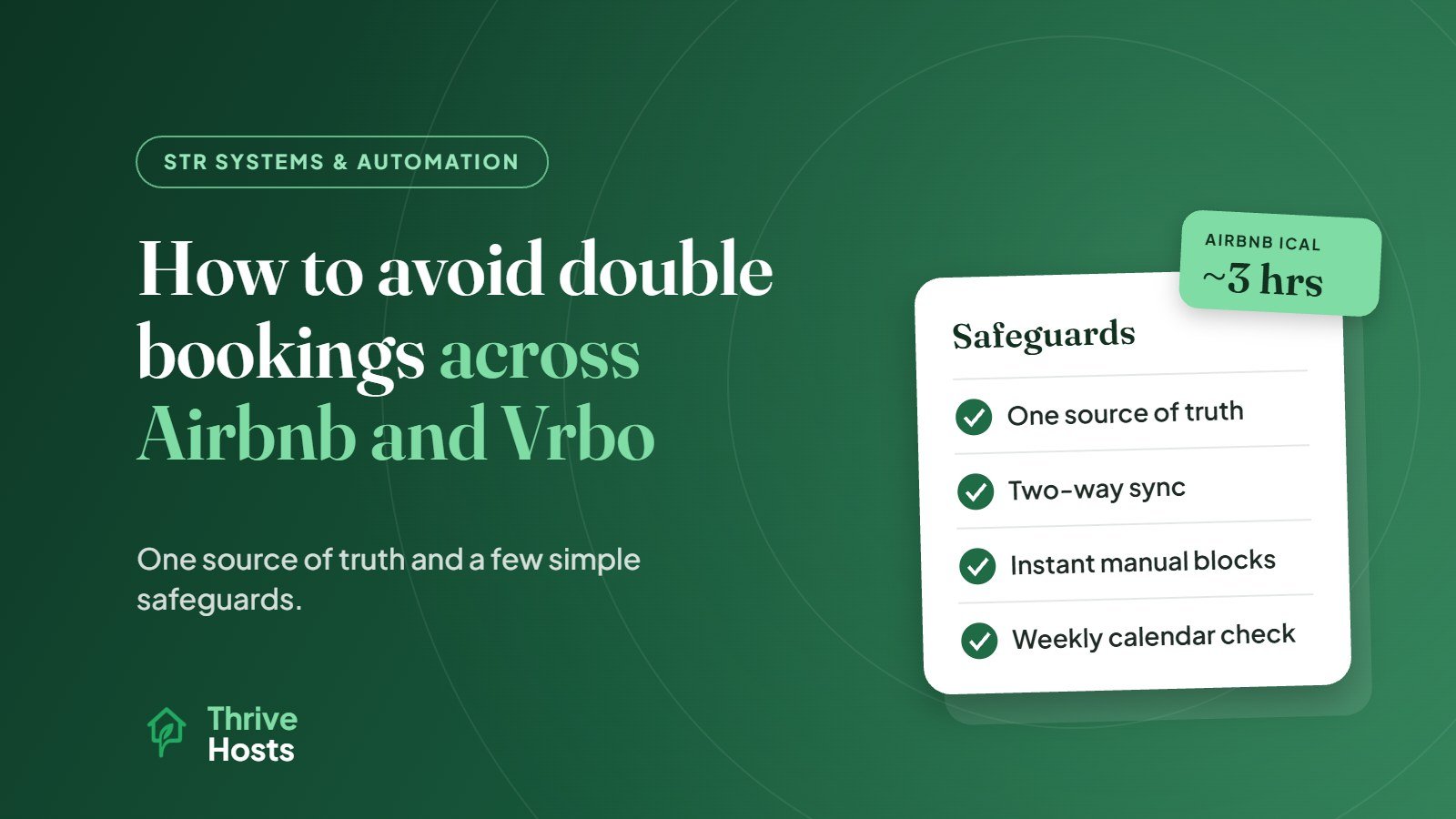
To avoid double bookings across Airbnb and Vrbo, make one system the source of truth for availability, connect both platforms to it as directly as possible, and add a few safeguards for the moments when sync is slow or someone edits a calendar by hand. In practice that means using a channel manager or PMS with API connections where you can, configuring iCal carefully if you cannot, and checking calendars regularly rather than assuming they match.
Double bookings rarely come from one big failure. They come from small gaps: a sync delay during a busy weekend, a date blocked on one platform but not the other, a direct booking nobody entered, or a cancellation that reopened dates in only one place.
Why Double Bookings Happen
Sync delays
iCal calendar links do not sync instantly. Airbnb’s help center says imported calendars update automatically every 3 hours, unless refreshed manually, and other platforms run on their own schedules. If a guest books on Vrbo and someone else books the same dates on Airbnb before Airbnb’s next refresh, both bookings can be confirmed.
One-way or missing connections
A common setup error is importing Vrbo into Airbnb but not Airbnb into Vrbo, or connecting the wrong listing’s calendar link. The calendars appear to work until the day a booking lands on the side that is not connected.
Manual blocks and direct bookings
Dates blocked by hand, such as for a family visit, a repair or a direct booking from a returning guest, often get entered on one platform only.
Settings that differ between platforms
Preparation time, advance notice and minimum stays do not always carry across through iCal. Airbnb notes that nights blocked on another calendar may or may not block on Airbnb depending on those settings, which can leave unexpected gaps.
Safeguard 1: Choose One Source of Truth
Decide where availability lives. For most hosts listing on two or more platforms, that should be a channel manager or PMS connected to Airbnb and Vrbo through their APIs. Bookings, blocks and changes are made there, and pushed out to both platforms. If you are unsure whether you need one, our guide on whether Airbnb hosts need a channel manager covers the decision.
Once a central system is in place, avoid editing availability directly on Airbnb or Vrbo. Manual edits on a channel are one of the most common causes of double bookings in otherwise well-connected setups.
Safeguard 2: If You Use iCal, Set It Up Properly
iCal can work for a single property with moderate demand if it is configured carefully:
- Connect both directions: export Airbnb’s calendar into Vrbo and Vrbo’s into Airbnb.
- Check the right listing: with several properties, confirm each link belongs to the correct listing.
- Include every channel: if you also use Booking.com or a direct site, every calendar must import every other one.
- Refresh manually after bookings: when a booking arrives, refresh the other platform’s calendar rather than waiting for the automatic sync.
- Test it: block a date on one platform and confirm it appears on the other.
Safeguard 3: Reduce Risk on Last-Minute Dates
The gap between syncs matters most for bookings made close to arrival, when both platforms may have the same nights available and demand is high. Some hosts using iCal set a longer advance notice period on their secondary platform, so last-minute bookings can only come through their main channel. It is a trade-off, since you may lose some short-notice bookings, but it reduces the overlap window where double bookings happen.
Safeguard 4: Block Direct and Personal Bookings Immediately
Any booking that does not come through a connected platform, such as a direct booking, a friend staying, or owner use, must be entered in your source of truth the moment it is agreed. Make it a rule, and make sure everyone who can accept bookings follows it.
Safeguard 5: Check Calendars Regularly
Even with good tools, connections can fail silently: an expired token, a changed listing, a disconnected calendar. A quick weekly check comparing the next 60 to 90 days across platforms catches problems before a guest does. Look for dates booked on one platform but open on another, and blocks that do not match.
What to Do If a Double Booking Happens
Act quickly. Contact the affected guest as soon as you notice, explain honestly, and help them find an alternative. Contact the platform’s support as well, because they may help with rebooking. Then find out why it happened and fix the cause before the next booking.
Cancelling a confirmed booking has real consequences. Airbnb charges host cancellation fees and may block the calendar, and on Vrbo a 0% partner-initiated cancellation rate is part of the standard for Premier Host. Our guide to optimizing a Vrbo listing explains why reliability carries so much weight there.
The Short Version
- One source of truth for availability.
- API connections where possible, two-way iCal if not.
- No manual edits on individual channels.
- Immediate blocks for direct and personal bookings.
- A weekly calendar check across every platform.
For managing several platforms beyond calendar sync, including rates, messages and listing content, see how to manage multiple booking channels from one system.
If you sell several rooms of the same type, as hotels and motels do, see how to prevent overbooking at a small hotel.
Getting Your Calendars Covered
Thrive Hosts manages multi-channel calendars as part of remote short-term rental operations support: channel connections across Airbnb, Vrbo and Booking.com, calendar checks, direct booking blocks and fast response if anything goes wrong.
You keep ownership of every listing and account. We keep the calendars aligned and watched.
Related reading: Why iCal calendar sync lags.
Explore STR operations support
We will check how your calendars are connected today and show you where a double booking could slip through.
Explore STR Operations Support
Bruce J is the CEO of Thrive Hosts and leads the short-term rental team. He works on the operations and performance side of STR: guest communication, pricing and calendar discipline, turnovers, issue tracking and owner reporting across Airbnb, Vrbo and Booking.com. On the blog he writes practical, no-fluff guides for owners and operators who want their rentals to run more consistently.