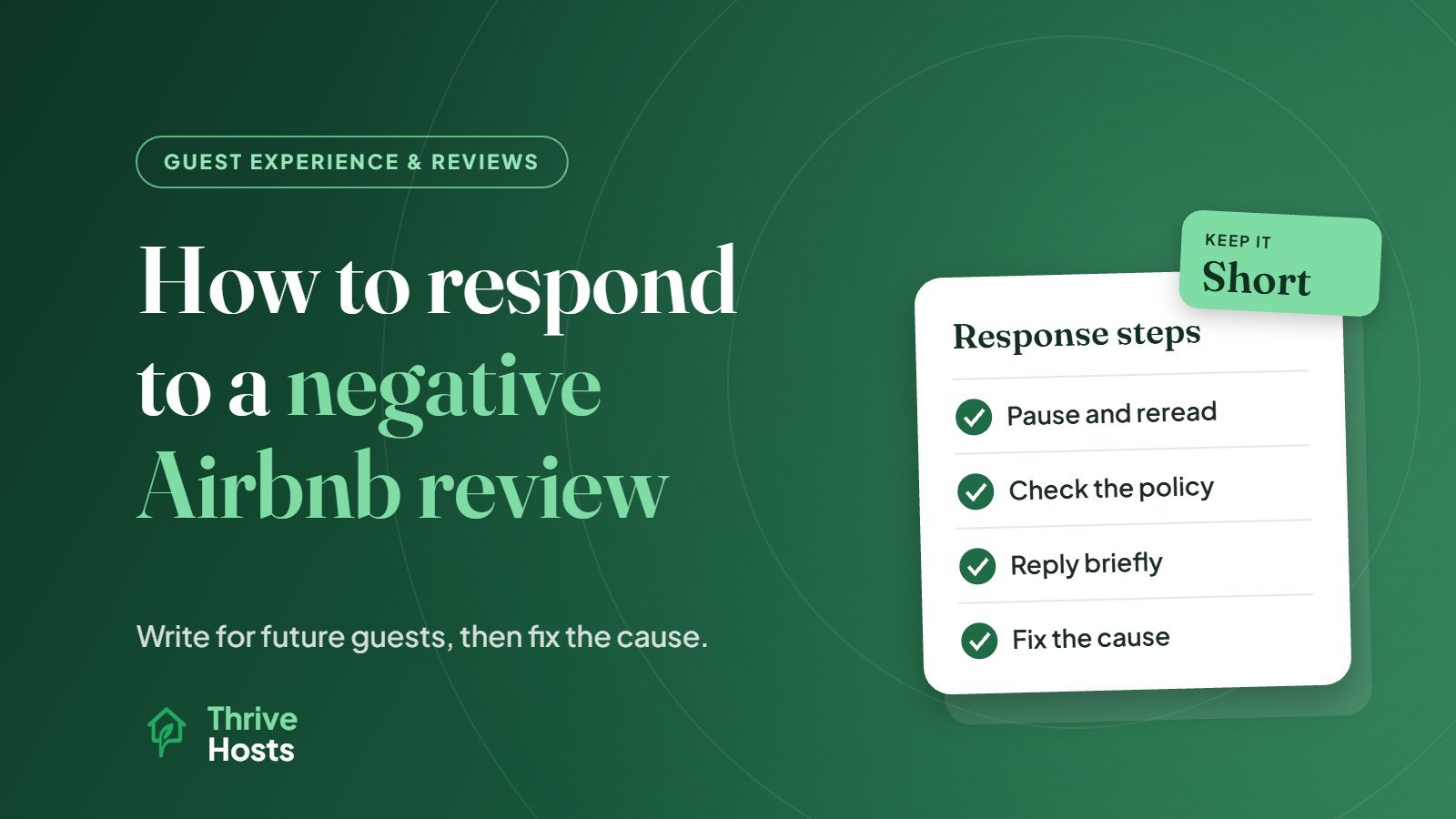
When you get a negative Airbnb review, respond publicly, briefly and calmly, and write for the guests who will read it later rather than for the guest who wrote it. Acknowledge the experience, address any factual issue in a sentence or two, explain what you have done about it if anything, and stop there. A measured response can reassure future guests. An argumentative one usually does more damage than the review itself.
Before you write anything, though, give yourself some time. Most poor review responses are written in the first hour.
To draft a calm first version quickly, try the free review response builder. It turns the review type, the issue raised and what you’ve fixed into a short public reply you can edit before posting.
Step 1: Pause and Read It as a Future Guest Would
A critical review feels personal, especially when you know the stay went better than the guest describes. Read it twice, then read it as a stranger deciding whether to book. What would worry them? Is it a one-off complaint about something outside your control, or does it point to a real issue such as cleanliness, check-in or accuracy?
Then check your other recent reviews. If the same issue has come up before, the review is useful information, however uncomfortable. If it is an outlier surrounded by consistent positive reviews, most future guests will see it that way too.
Step 2: Check Whether It Breaks Airbnb’s Rules
Airbnb removes reviews only in limited circumstances. Its reviews policy is clear that disagreeing with a star rating, subjective opinions and factors outside the host’s control generally do not qualify. Reviews can be removed when they violate the policy, for example where they are not relevant or authentic, or break Airbnb’s content rules.
The policy also covers retaliation narrowly. A review is only treated as retaliatory if the reviewer committed a policy violation, and discussing the facts of a damage claim is not automatically retaliatory. If you believe a review genuinely breaks the rules, contact Airbnb support with the details and any message history. If it does not, focus on your response instead of removal.
Step 3: Write a Short, Professional Response
Good responses tend to follow the same simple shape:
- Thank the guest for staying and for the feedback.
- Acknowledge the specific issue without repeating every detail.
- Clarify facts briefly if something is inaccurate, without arguing.
- Explain what has changed, if you have fixed something.
- Close politely. Keep it to a few sentences.
Here is the difference in practice. A defensive reply might say: “This guest arrived three hours late, ignored our instructions and never told us about the shower until checkout. Every other guest has loved our place.”
A stronger reply to the same review: “Thank you for staying with us, and I’m sorry the shower pressure was disappointing. We were not made aware of it during the stay, but we have since had it checked and the fixture replaced. We hope future guests enjoy the improvement.”
The second version still makes the relevant point, that the host was not told, but it reads as calm and responsible. Future guests notice that difference.
What to Avoid in Your Response
- Arguing or blaming. Even if you are right, a combative reply makes you look difficult to deal with.
- Personal details. Do not share the guest’s private information, or details of their behavior beyond what is necessary.
- Long explanations. If your response is longer than the review, it is probably too long.
- Copy-paste replies. Generic responses on every review look automated and unconcerned.
- Mentioning money or claims in a hostile way. If there is an ongoing damage claim, keep the response neutral and factual.
Step 4: Fix the Underlying Problem
A response handles the public side. The more important work is operational. If the review mentions cleanliness, talk to your cleaner the same day and update the checklist. If it mentions confusing check-in, rewrite the instructions and add photos. If it mentions something in the listing that was not accurate, correct the listing. If a maintenance issue is mentioned, log it and make sure it is closed before the next arrival.
This is also how you stop one negative review becoming several. Our guide on improving Airbnb reviews without asking for 5 stars covers the operational habits that lead to consistently stronger reviews.
Step 5: Consider a Private Message
Sometimes a short private message to the guest is appropriate, particularly if their experience was genuinely poor. Thank them for the feedback, acknowledge the problem and mention what you have changed. Do not use this message to ask them to change their review or to offer anything in exchange for doing so. Airbnb’s policy prohibits pressuring guests or trading something of value for a review.
Keep One Review in Perspective
One critical review among many positive ones rarely decides a booking on its own. Guests tend to look at patterns and recent reviews, and at how hosts respond. A thoughtful reply can actually build trust, because it shows how you behave when something goes wrong.
What matters more is whether the same issue appears again. Track your reviews monthly and treat repeated comments as an operational priority. If the review came out of a tense stay, our guide on handling difficult Airbnb guests covers how to manage those situations earlier.
If you run a motel or small hotel, our guide on how motels should respond to guest reviews includes example replies for Booking.com, Expedia and Google.
Getting Help With Reviews and Guest Issues
Thrive Hosts supports owners with review responses, guest communication and the operational follow-up that prevents repeat complaints, as part of remote Airbnb co-hosting. We help draft calm, professional responses and make sure the underlying issue is tracked with your local team until it is resolved.
You keep your listing and accounts. We help you handle the difficult reviews well and see fewer of them over time.
Get help with reviews and guest issues
We will look at your recent reviews, how they have been answered, and what is driving the critical ones.
See How Airbnb Co-Hosting Works
Bruce J is the CEO of Thrive Hosts and leads the short-term rental team. He works on the operations and performance side of STR: guest communication, pricing and calendar discipline, turnovers, issue tracking and owner reporting across Airbnb, Vrbo and Booking.com. On the blog he writes practical, no-fluff guides for owners and operators who want their rentals to run more consistently.