Superhost is the badge hosts talk about most, and also the one they misunderstand most. It is not an award for effort and it does not guarantee more bookings. It is a status that Airbnb recalculates every quarter based on a small set of numbers, and it can be lost as easily as it was earned. Knowing exactly what is measured makes it much easier to protect.
The requirements, as Airbnb states them
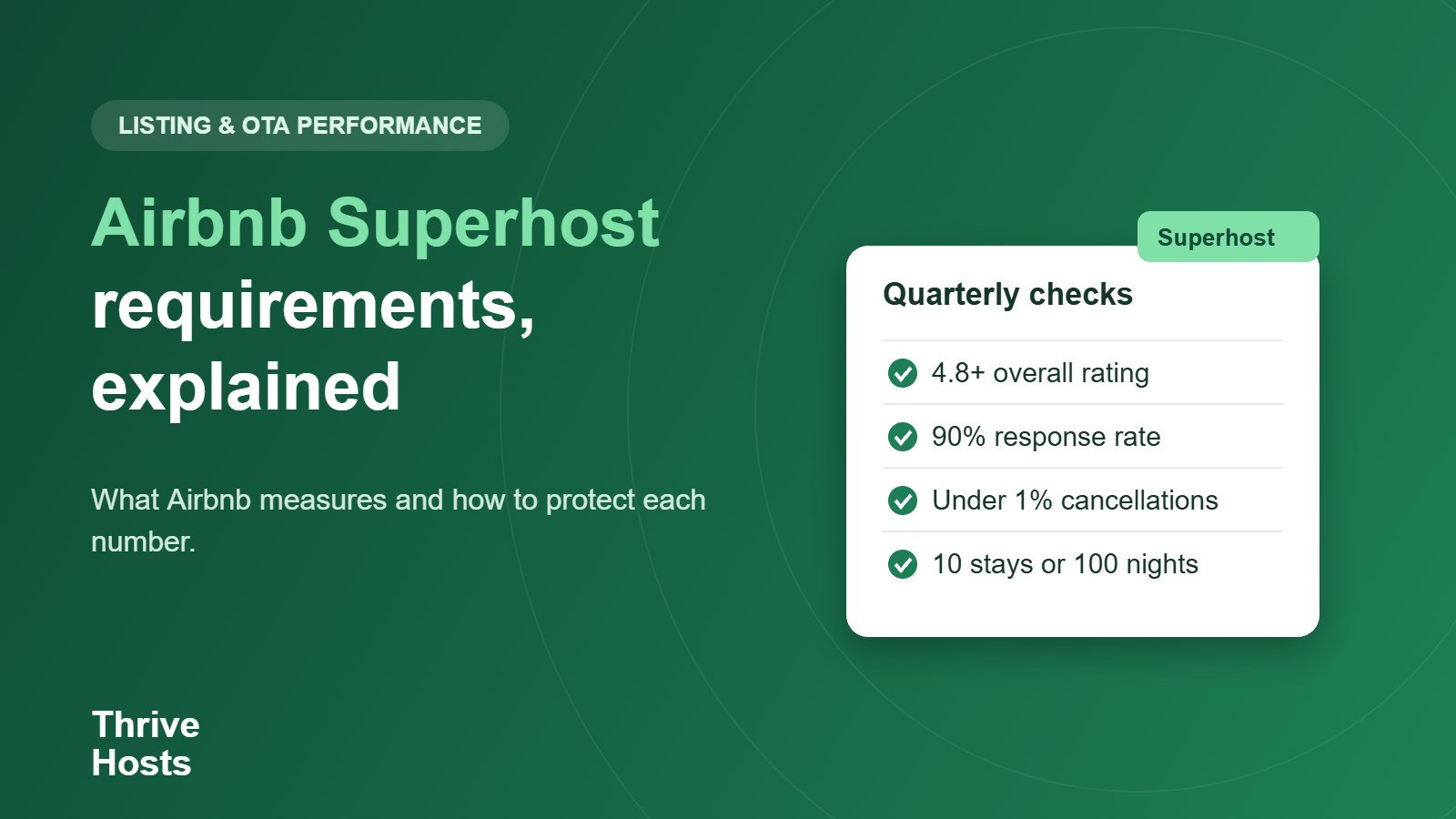
According to Airbnb’s Help Center, to qualify you must be the listing owner of a home listing with an account in good standing and meet four thresholds.
- Reservations hosted: at least 10 reservations, or 3 reservations totalling 100 nights or more.
- Response rate: respond to 90% of new messages and accept or decline new reservation requests within 24 hours. Declining requests does not hurt your status.
- Cancellation rate: below 1%, not counting cancellations caused by Major Disruptive Events or other valid reasons.
- Overall rating: 4.8 or higher.
Airbnb checks these every three months over the previous 12 months, though you do not need to have hosted for all 12. Each assessment runs for seven days, starting on January 1, April 1, July 1 or October 1. A review counts once both sides have submitted one, or when the 14-day review window closes, whichever comes first. Check the current wording in your own host dashboard, which also shows your progress on each requirement, since requirements can change and may differ by region.
Which requirement is hardest to protect
For most hosts it is the rating. A 4.8 average leaves very little room, so a handful of three-star reviews can pull a listing below the threshold, especially a newer one with few reviews. The response rate is usually manageable with scheduled messages and a clear process, and the cancellation rate is controllable as long as you avoid host cancellations. The rating, by contrast, depends on guest experience, which means cleanliness, accuracy of the listing, check-in and communication. Our guides on improving Airbnb reviews and handling difficult guests cover the practical side.
Response rate: more than speed
The 90% figure covers new messages and requests, so a missed overnight enquiry counts. If you are travelling or working a different shift, set up a way for someone to monitor the inbox, and check that notifications actually reach a person. See Airbnb host response time for how to cover gaps.
Cancellations are the easiest way to lose it
A host cancellation, whether because of a double booking, a maintenance problem or a calendar error, counts against the 1% limit, which for a small number of reservations can be a single event. Keep calendars synced across platforms and treat any reservation you might need to cancel as a serious problem. Our article on avoiding double bookings explains the common causes.
What the badge does and does not do
Airbnb says Superhosts get a badge on their listing and profile, more visibility and earning potential, and access to rewards. It does not describe a specific ranking boost or a guaranteed increase in bookings, so treat the badge as a trust signal rather than a shortcut. Plenty of strong listings perform well without it, and chasing the badge at the expense of good decisions, for example by refusing every difficult but profitable booking, is a mistake.
Who owns the status when a co-host is involved
Superhost status is tied to the listing owner’s account. If a co-host handles messages and guest issues, their performance affects your numbers. Make sure the response times and cancellation rules are part of the arrangement, as we describe in what to include in an Airbnb co-host agreement.
Keep the status
- Look at your current progress in the host dashboard each month.
- Keep calendars synced to avoid host cancellations.
- Cover the inbox at all hours so no message is missed.
- Fix small problems quickly, before they become a review.
- Review feedback every month for patterns.
- Treat the badge as a signal, not a goal.
Related reading: Removing or responding to a bad review.
Missing Superhost by a small margin?
Thrive Hosts helps owners improve the details behind the numbers: faster guest messaging, calendar accuracy, issue follow-up and review patterns. See how our Airbnb co-hosting service supports owners who want consistent performance.
Explore Airbnb co-hosting
Bruce J is the CEO of Thrive Hosts and leads the short-term rental team. He works on the operations and performance side of STR: guest communication, pricing and calendar discipline, turnovers, issue tracking and owner reporting across Airbnb, Vrbo and Booking.com. On the blog he writes practical, no-fluff guides for owners and operators who want their rentals to run more consistently.