Most co-hosting arrangements start with a conversation and a handshake. That works until the first dispute: a cleaner bill nobody approved, a guest refund the owner did not expect, or a disagreement about whether the fee applies to cleaning charges. A written agreement does not need to be long, but it should answer the questions both sides will otherwise answer differently later.
This is a practical checklist of what to cover. It is not legal advice, and a local attorney should review the final document, especially where short-term rental rules or tax obligations are involved.
Define the scope of work in plain terms
Start with what the co-host actually does. “Manages the listing” is too vague to be useful. Spell out whether the co-host handles guest messaging, calendar and pricing changes, cleaner scheduling, vendor coordination, review responses and owner reporting, and say clearly what stays with the owner. If you are still working out the split, our guide on what to outsource first on Airbnb helps separate routine tasks from owner decisions.
It also helps to state what is not included. Physical work such as cleaning, repairs, restocking and on-site inspections is normally done by local vendors, and the co-host coordinates them rather than doing the work personally. Writing that down avoids assumptions in either direction.
Set spending and decision limits
Decide what the co-host can approve without asking. A common approach is a per-incident amount, for example a repair or replacement under a set figure, with anything above it needing the owner’s approval. Add a short list of emergencies where the co-host can act first and report afterwards, such as a burst pipe or a lock failure with a guest outside. Without a limit, either the co-host asks about every small expense or the owner gets surprised by a large one.
Be exact about the fee
Fee disputes are the most common source of friction, and they usually come from an undefined base. Say whether the percentage applies to the nightly rate only or also to cleaning fees, pet fees and extra-guest charges. Say whether it is calculated before or after Airbnb’s service fee, and how taxes are treated. If there is a flat monthly component, note what happens in months with no bookings. You can model a few scenarios with the co-host fee calculator before settling on a structure.
Cover how and when payment is made. Airbnb states that only listing owners can set up or edit a co-host’s payouts, so the owner sets the payout split in the listing, and the agreement should say what share applies and from which payments.
Keep the account and the data with the owner
The listing, the Airbnb account, the reviews and the guest history belong to the owner. The agreement should say so, and it should say what access the co-host receives. Airbnb offers several co-host access levels, from calendar-only to full access, and the owner can change or remove a co-host’s permissions at any time. Pick the lowest level that lets the co-host do the agreed work. The owner remains responsible for any co-hosts on the listing under Airbnb’s rules, so access should be deliberate.
Agree on communication and reporting
Set expectations that can be checked: how quickly guest messages are answered, how urgent issues are escalated and by what channel, and what the owner receives each month. A monthly summary of bookings, revenue, issues handled and upcoming problems is usually enough. If you want a model, see how to run a short-term rental remotely.
Plan for damage, complaints and refunds
State who handles guest damage claims, who talks to Airbnb about them, and who decides on partial refunds or goodwill gestures. A refund budget per stay is often simpler than case-by-case approval. Also say what happens when a guest complaint is the result of an owner decision, such as a delayed repair, so accountability is clear.
Include a way out
Every agreement should have a term, a notice period for ending it, and a handover process: returning vendor contacts, shared documents, access codes and any pending bookings or payments. Add confidentiality for guest data and owner information, and a clause confirming that each party follows local short-term rental licensing and tax rules. Insurance is worth a line too, since a co-host acting on the owner’s behalf does not replace the owner’s own coverage.
A quick checklist before signing
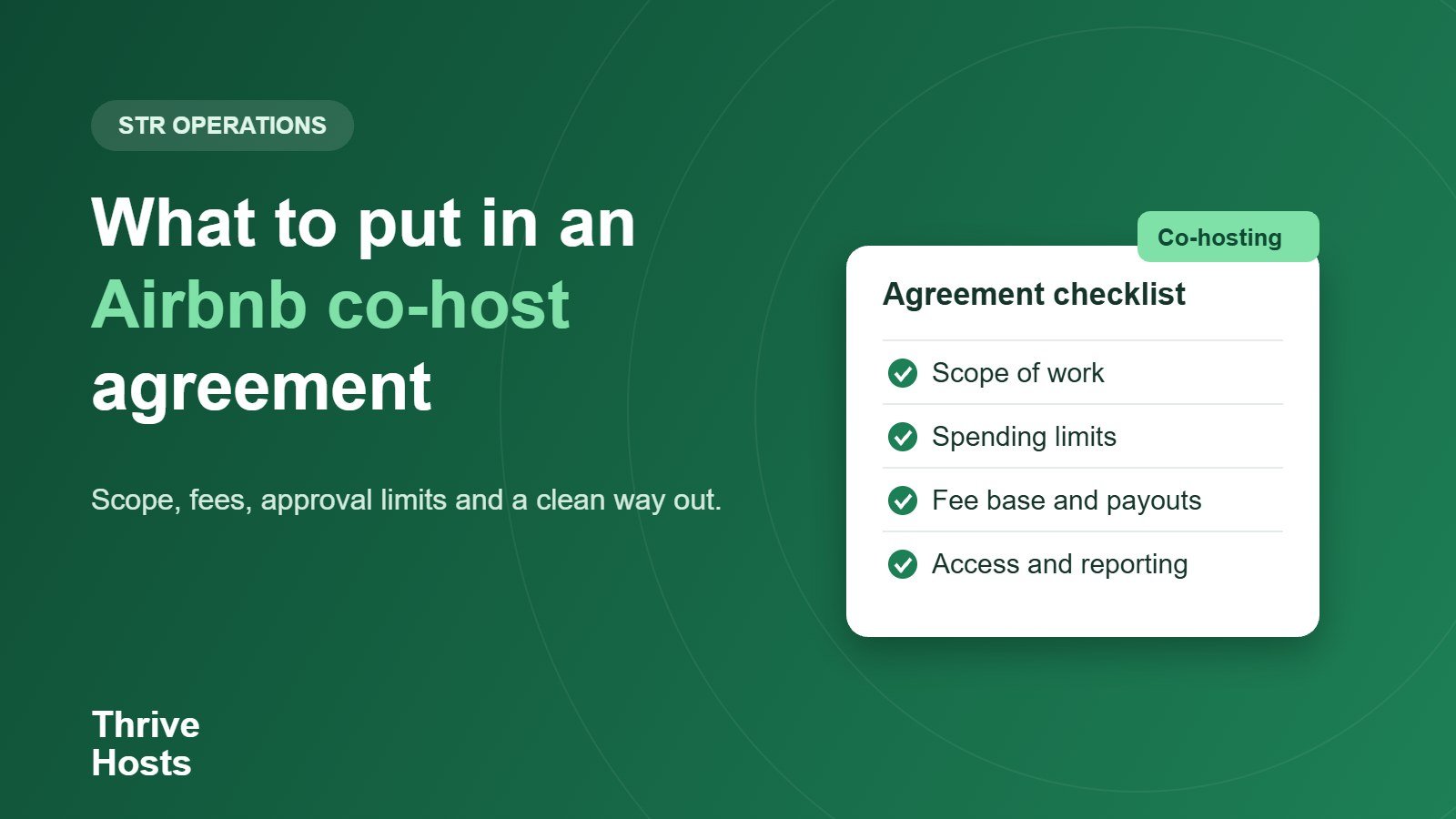
- Scope of work and exclusions are written down.
- Spending limit and emergency authority are defined.
- Fee base, timing and payout split are specific.
- Access levels are set and the account stays with the owner.
- Response times and monthly reporting are agreed.
- Damage, refund and complaint handling has an owner.
- Term, notice period and handover steps are included.
Related reading: Airbnb co-host refund changes from December 2026.
Want a co-host who works from a clear agreement?
Thrive Hosts handles guest communication, cleaner coordination, calendar and pricing support and owner reporting remotely, with the scope and approval limits agreed up front. If you are weighing options, start with how our Airbnb co-hosting service works, or compare it with a property manager.
Explore Airbnb co-hosting
Bruce J is the CEO of Thrive Hosts and leads the short-term rental team. He works on the operations and performance side of STR: guest communication, pricing and calendar discipline, turnovers, issue tracking and owner reporting across Airbnb, Vrbo and Booking.com. On the blog he writes practical, no-fluff guides for owners and operators who want their rentals to run more consistently.