The short answer: an Airbnb co-host works inside your listing and your accounts, helping run it alongside you, while a traditional property manager usually takes over the operation of the property and often the listing itself. Both can take work off your plate. The difference is how much control you hand over, who the guest relationship sits with, and how the work and fees are structured.
The two terms get blurred because some property managers call themselves co-hosts and some co-hosts offer near full-service packages. So it is more useful to compare the models than the labels.
What an Airbnb Co-Host Is
On Airbnb, co-host is a specific feature. The listing owner invites someone to help manage a listing and chooses their access level. According to Airbnb’s help center, there are three permission levels: full access, which covers the listing, pricing, reservations, messaging and earnings; calendar and messaging access; and calendar-only access. A listing can have up to 10 co-hosts, and only the listing owner can set up or change co-host payouts.
That structure tells you a lot about the model. The listing stays yours. Your reviews, your Superhost history and your payout method stay attached to your account. The co-host works within limits you set and can be removed without rebuilding the listing.
Outside the Airbnb feature, “co-hosting” is also used as a service description: someone handling guest messages, pricing, calendar management, listing optimization and cleaner coordination for the owner, often across Vrbo and Booking.com as well. Many co-hosts work remotely and coordinate with a local cleaner and handyperson rather than doing on-site work themselves.
What a Property Manager Usually Does
A traditional short-term rental property manager typically takes responsibility for the whole operation. That often includes their own cleaning and maintenance teams, in-person inspections, linens, guest emergencies on site, and marketing across channels. In many cases the property is listed under the manager’s account or brand, using their own software, pricing approach and policies.
That model suits owners who want to be almost completely hands-off and are comfortable with less day-to-day visibility. The trade-off is control. If the listing lives on the manager’s account, the reviews and booking history usually stay with them when you leave, and switching managers can mean starting a listing again from zero.
Property management agreements also tend to be more formal: longer terms, notice periods, and in some places licensing requirements for the manager. Rules vary by country, state and city, so check what applies to your area before signing anything.
The Key Differences Side by Side
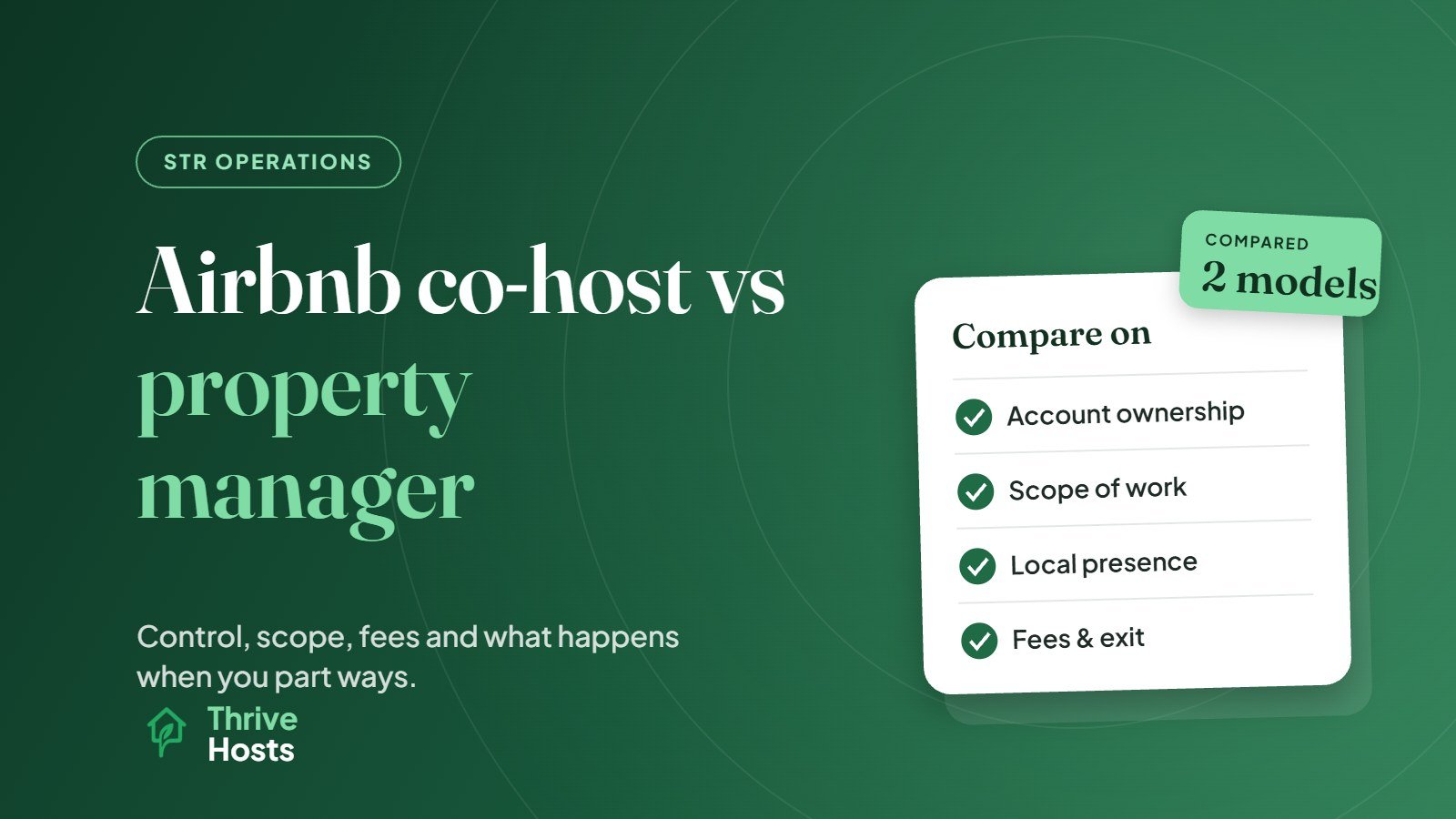
Control and account ownership
With a co-host, the owner keeps the listing, the accounts and the final say on major decisions. With a property manager, decision-making often moves to the manager, and the listing may sit on their account.
Scope of work
A co-host’s scope is usually defined task by task: messaging, pricing, calendar, listing upkeep, coordination. A property manager’s scope tends to be everything, including physical work through their own staff.
Local presence
Property managers are usually local and can send someone to the property. Co-hosts may be local or remote. A remote co-host depends on a reliable local team, which the owner often already has or chooses.
Fees
Both commonly charge a percentage of booking revenue, though fixed monthly fees exist too. Because a property manager carries more work and more staff, their fee is generally higher. Compare what is included rather than the headline percentage.
Exit
Ending a co-host arrangement on Airbnb can be as simple as removing them from the listing. Leaving a property manager can involve notice periods, transferring future bookings and, if the listing was theirs, losing its history.
Which One Fits Your Situation?
A co-host tends to fit owners who want to stay involved in the important decisions, already have or can build a local cleaning and maintenance team, and want help with the recurring work rather than a full handover. It also suits owners who care about keeping their listing history, reviews and pricing data on their own account.
A full property manager tends to fit owners who want a complete hands-off arrangement, have no local support at all, and are comfortable giving up some control for that convenience.
There is also a middle ground many owners end up in: a remote co-host or operations partner handling guest communication, pricing, calendar and coordination, with a local cleaner and handyperson doing the physical work. That gives you most of the time savings of a property manager without handing over the listing. If you are trying to understand what that operational role covers in practice, our article on what an STR operations manager actually does goes into the day-to-day detail.
Questions to Ask Before You Choose
- Whose account will the listing live on, and what happens to it if we part ways?
- Which tasks are included, and which are charged extra?
- Who does physical work at the property, and who chooses those people?
- What decisions need my approval, and what is the spending limit without it?
- How often will I get reporting, and what will it include?
- What is the notice period, and how are future bookings handled when it ends?
How Thrive Hosts Fits
Thrive Hosts is not a traditional property manager. We provide remote Airbnb co-hosting and short-term rental operations support across Airbnb, Vrbo and Booking.com. That means guest messaging, listing management, pricing and calendar oversight, coordination with your approved local cleaner and vendors, issue tracking and owner reporting.
Your listing stays on your account, and you keep the decisions that matter. We handle the recurring work that would otherwise pull you back into the app every few hours.
See how Airbnb co-hosting works
Find out what a remote co-host would handle for your listing, what stays with you, and how it works with your local cleaning team.
See How Airbnb Co-Hosting Works
Bruce J is the CEO of Thrive Hosts and leads the short-term rental team. He works on the operations and performance side of STR: guest communication, pricing and calendar discipline, turnovers, issue tracking and owner reporting across Airbnb, Vrbo and Booking.com. On the blog he writes practical, no-fluff guides for owners and operators who want their rentals to run more consistently.