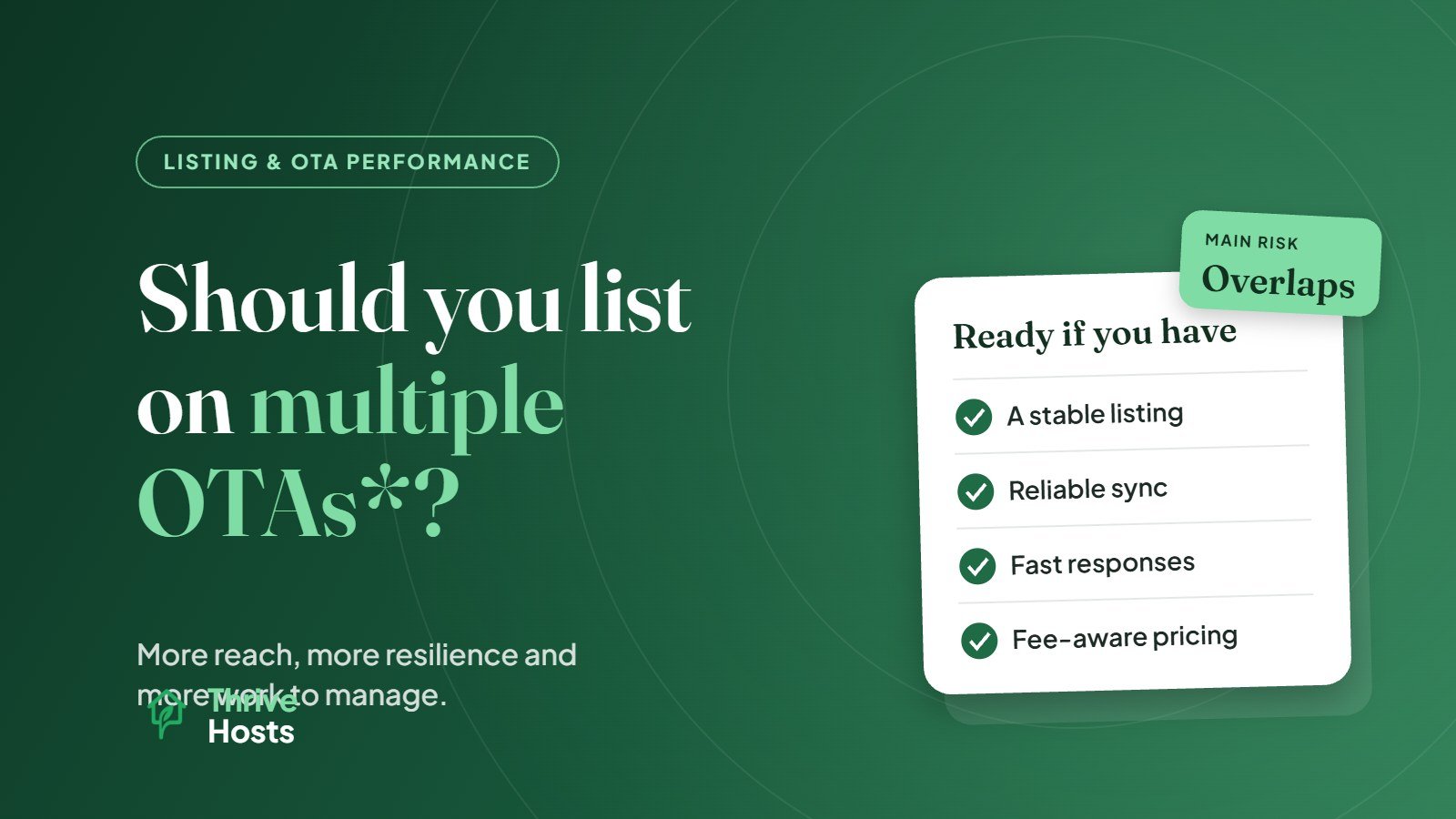
Listing on multiple OTAs can widen your reach and reduce dependence on a single platform, but it also adds operational work: more calendars to sync, more inboxes to answer, more settings to keep aligned and a higher risk of double bookings if the setup is not reliable. For many owners, adding a second platform makes sense once the first listing is running smoothly and there is a system in place to manage both. Adding a third is a separate decision that depends on the property and market.
If you add a second channel, the free channel price calculator shows what to charge on each platform so every booking nets you the same amount per night.
Why owners list on more than one platform
The main reasons are reach and resilience. Each OTA has its own audience, and some guests only search on one. A whole home that suits families may find bookings on Vrbo that never would have come through Airbnb. A city apartment may pick up international or business travellers on Booking.com.
Resilience matters too. If all your bookings come from one platform, you are exposed to its algorithm changes, fee changes, policy updates and any issues with your account. Spreading bookings across channels makes your income less dependent on a single company’s decisions. For a sense of how the three main platforms differ, see our comparison of Airbnb vs Vrbo vs Booking.com.
The real costs of multi-listing
The costs are mostly operational rather than financial.
Calendar risk. Every additional channel is another place a booking can come from. If availability is not synced quickly and reliably, two guests can book the same dates. Basic iCal syncing updates on a delay, which leaves a window for overlaps, especially for last-minute bookings. Our guide on avoiding double bookings across Airbnb and Vrbo explains how this happens.
More communication. Each platform has its own inbox, response expectations and review system. Missing messages on a secondary channel can hurt that listing’s performance.
More settings to maintain. Prices, minimum stays, fees, house rules, cancellation policies and listing content need to be set up on each platform and kept aligned when anything changes. Inconsistencies confuse guests and create disputes.
Different policies and fee structures. Each platform calculates fees and payouts differently, so the same nightly rate can produce different net income. Pricing needs to account for that.
Signs you are ready to add another OTA
Multi-listing tends to work best when a few things are already true:
- Your first listing is stable, with good reviews and a reliable turnover process
- You have accurate, current content and photos you can reuse
- You have a dependable way to sync calendars, ideally a channel manager or PMS rather than manual iCal links alone
- Someone can respond promptly on every platform, including weekends
- Your pricing accounts for each platform’s fees
If any of those are missing, adding a channel is likely to create more problems than bookings.
When a single platform may be enough
Not every property needs multiple OTAs. If your occupancy is already strong on one platform at healthy rates, the extra bookings from a second channel may be small compared with the extra work. Properties with very specific rules, unusual access arrangements or a strong reliance on guest screening may also find one well-managed channel easier.
The question to ask is whether you have unsold nights that a different audience would book, not simply whether more platforms means more bookings.
How to add a second platform sensibly
Start with the platform that best fits your property’s guests. Set up the listing completely rather than copying text across without adjusting for how the platform works. Connect calendars before going live and test the sync with a blocked date. Set pricing that reflects the platform’s fee structure. Then watch the first few weeks closely for messaging gaps or sync issues before considering anything further.
A channel manager or PMS becomes more valuable with every platform you add, because it lets you manage availability, rates and messages from one place. Our guide on managing multiple booking channels from one system explains the setup, and our article on keeping listings consistent across Airbnb, Vrbo and Booking.com covers the content side.
Thinking about adding a channel?
Thrive Hosts manages Airbnb, Vrbo and Booking.com listings remotely, including calendar sync, pricing across platforms and guest messaging in every inbox. We can help you decide whether another OTA makes sense and set it up properly if it does.
Explore OTA Listing Support
Bruce J is the CEO of Thrive Hosts and leads the short-term rental team. He works on the operations and performance side of STR: guest communication, pricing and calendar discipline, turnovers, issue tracking and owner reporting across Airbnb, Vrbo and Booking.com. On the blog he writes practical, no-fluff guides for owners and operators who want their rentals to run more consistently.