Running one short-term rental informally usually works. You know the cleaner by name, the Wi-Fi password is in your head, and you can spot a problem in the calendar because there is only one calendar to look at. The trouble starts around the second or third property. The same habits that kept one listing running smoothly start to collide: two turnovers land on the same morning, a guest message sits unanswered because you were dealing with another unit, and nobody can quite say which property actually made money last month.
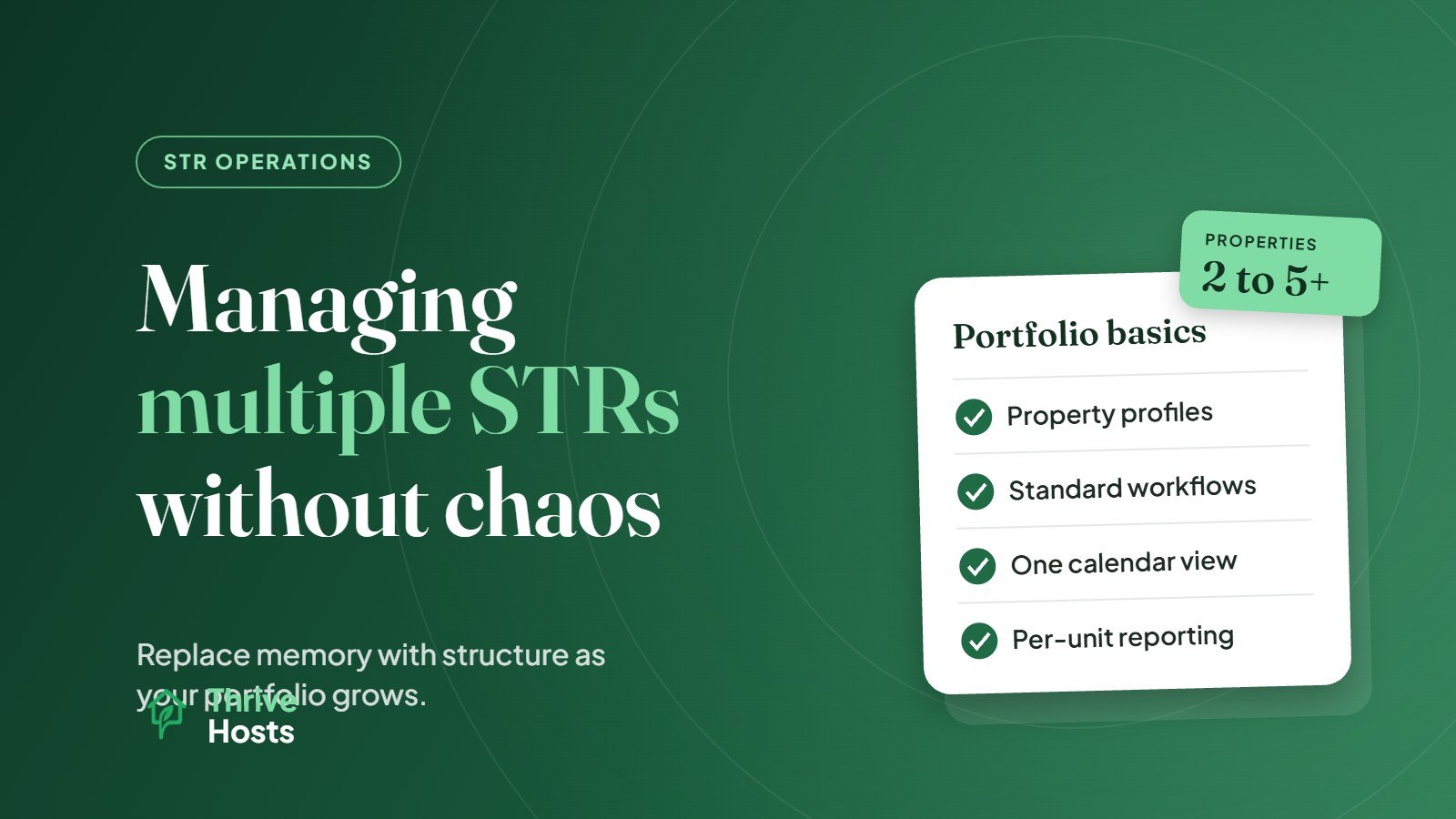
Managing multiple short-term rental properties without chaos is less about working harder and more about replacing memory with structure. Here is what that looks like in practice.
Why multi-property operations break down
Most portfolios do not fall apart because of one big failure. They wear down through small, repeated misses. A cleaner gets the wrong checkout time. A guest at Unit B receives the door code for Unit A. A price that was right in spring is still live in October. Each mistake is minor, but together they create the feeling that you are always reacting.
The underlying cause is nearly always the same: information lives in people’s heads, in scattered text threads and in separate platform inboxes, instead of in one place everyone can see. When there was one property, you were the system. With several, you become the bottleneck.
Build a property profile for every unit
The first fix is a single reference document per property. It should hold everything someone would need to run that unit without calling you: access details, Wi-Fi, parking instructions, appliance quirks, the cleaner and backup cleaner, preferred local vendors, linen par levels, house rules and any listing-specific promises such as early check-in policies.
This sounds basic, but it is the step most owners skip. Without it, every new cleaner, co-host or assistant has to learn each property by trial and error, and guests end up being the ones who discover the gaps. A good property profile also makes your short-term rental operations checklist usable across units, because the checklist can point to the profile rather than repeating details.
Standardize what can be standardized
Properties differ, but most of the work around them follows the same pattern. Guest messaging, turnover steps, restocking, review responses and issue logging can all use one shared approach with small per-property variations.
Practical places to standardize include:
- Message templates for booking confirmation, pre-arrival, check-in, mid-stay and checkout, with property-specific fields filled in
- One turnover checklist structure, with a short add-on section for each unit
- A single way of logging issues, including who reported it, what was done and whether it is resolved
- The same supply list format, so restocking does not depend on someone remembering what that unit uses
The goal is not to make every property identical. It is to make sure the differences are written down instead of remembered.
Give the calendar one source of truth
Calendar mistakes get more expensive with every listing you add. If you list on more than one platform, connected calendars or a channel manager become important, and it is worth understanding how double bookings across Airbnb and Vrbo actually happen before they do.
Beyond availability, the calendar should drive your turnover schedule. When cleaners can see checkout and check-in times for all units in one view, same-day turnovers and tight windows become visible days in advance rather than on the morning of. That gives you time to arrange a backup cleaner or adjust check-in timing with the guest.
Plan cleaner capacity across the portfolio
One cleaner can often handle a single property comfortably. Several properties with overlapping checkout days are a different situation. Busy Saturdays and Sundays tend to stack turnovers, and if one cleaner is sick, multiple units can be affected at once.
Look at your booking patterns and identify your peak turnover days. For those days, you want either enough cleaner capacity spread across the units or a confirmed backup who already knows the properties. The property profile helps here too, because a backup cleaner can work from it rather than guessing.
Track each property separately
A portfolio can look healthy overall while one unit quietly underperforms. Review occupancy, average daily rate, revenue, review scores and recurring issues per property, not just in total. A simple monthly view is usually enough to show which listing needs pricing attention, which one has a recurring maintenance pattern and which one is generating more guest messages than the others.
This is also where owner reporting becomes useful even if you are the only owner. A short monthly summary per unit turns vague impressions into decisions.
Decide who owns each task
As the portfolio grows, the question shifts from “how do I do this?” to “who does this?” Guest communication, pricing reviews, cleaner coordination, vendor follow-up and reporting are all recurring work. If you do not assign them clearly, they default back to you.
Some owners bring in an STR operations manager or a co-host for this layer. Others split it, keeping pricing decisions themselves and handing off messaging and coordination. Either way, the work needs a named owner and a routine, not an assumption that someone will notice.
Build the system before you need it
The easiest time to set up structure is before the next property arrives, not during a busy season when everything is already stretched. If you are planning to grow, it is worth looking at how a remote short-term rental management system fits together, so new units plug into an existing workflow instead of adding another layer of improvisation.
Chaos in a multi-property STR business is rarely a sign that you have too many properties. It is usually a sign that the operation is still running on the habits that worked for one.
Running several properties and feeling stretched?
Thrive Hosts provides remote STR operations support for owners with multiple listings, including guest communication, calendar and pricing management, cleaner coordination and owner reporting. You keep control of your properties and accounts; we help run the recurring work behind them.
Explore STR Operations Support
Bruce J is the CEO of Thrive Hosts and leads the short-term rental team. He works on the operations and performance side of STR: guest communication, pricing and calendar discipline, turnovers, issue tracking and owner reporting across Airbnb, Vrbo and Booking.com. On the blog he writes practical, no-fluff guides for owners and operators who want their rentals to run more consistently.