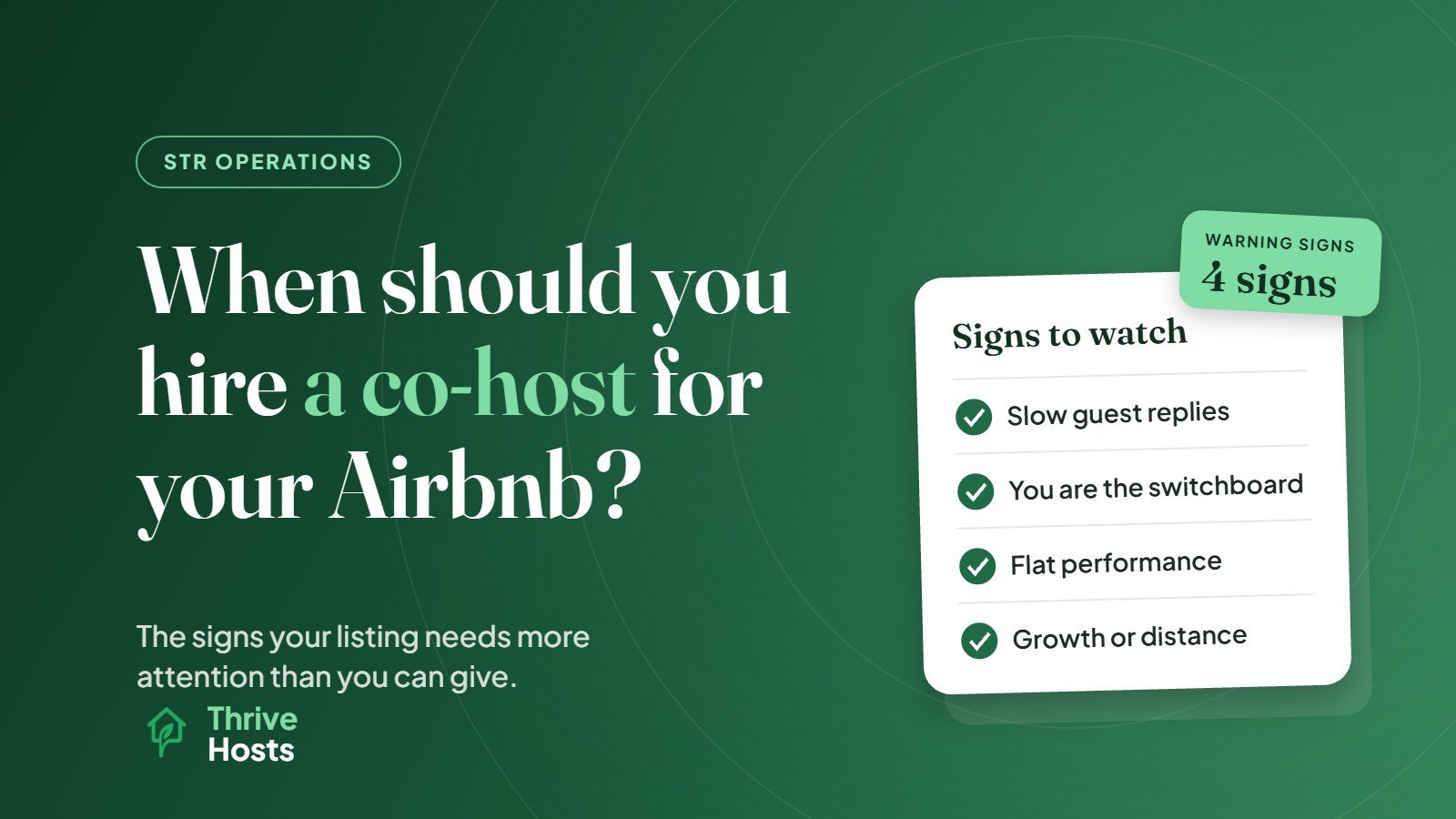
You should consider hiring a co-host for your Airbnb when the listing needs more consistent attention than you can give it. That usually shows up in one of three ways: guests are waiting too long for answers, the operational side (cleaners, maintenance, restocking) depends on you remembering everything, or performance has flattened because nobody has time to work on pricing and the listing itself.
It is less about the number of properties and more about the gap between what the listing needs and the time you actually have. Some owners need help with their very first listing because they live three hours away. Others run three properties comfortably on their own. Here is how to tell which side of that line you are on.
Sign 1: Guest Messages Are Starting to Wait
Responsiveness is one of the first things to slip when a host is stretched. A question about parking sits for four hours because you were in meetings. A booking inquiry arrives at 11pm and gets answered the next morning, by which time the guest has booked somewhere else.
Airbnb measures this directly. To keep Superhost status, hosts need to respond to 90% of new messages within 24 hours, alongside a 4.8 overall rating, a cancellation rate under 1% and a minimum number of stays. Twenty-four hours is the floor for status, though, not what guests expect. If you regularly find yourself apologising for slow replies, that is a clear signal.
Sign 2: You Are the Only Link Between Guests and Cleaners
In many self-managed listings, the owner is the switchboard. Bookings come in, the owner forwards dates to the cleaner, the cleaner reports a broken lamp to the owner, the owner contacts the handyperson. That works until you are travelling, ill or simply busy, and then the whole chain stops.
If a single missed message from you can result in an uncleaned property or an unresolved issue for the next guest, you have a single point of failure. A co-host can take over that coordination so it no longer depends on your availability.
Sign 3: Performance Has Plateaued
When time is short, hosts protect the urgent work and drop the important work. Messages and turnovers get handled; pricing reviews, calendar rules, photo updates and listing improvements do not. Months pass with the same nightly rates, the same minimum stay and the same first photo, while the market around you changes.
If your occupancy or revenue has stalled and you know the listing has not had real attention in a while, the problem may not be the property. It may be that no one is actively managing it. Our article on why an Airbnb listing is not getting bookings is a good place to diagnose this first.
Sign 4: You Are Adding a Property or Moving Away
Two life changes make the decision more urgent. The first is growth. Running a second or third listing is not twice the work of one; it is a different kind of work, because schedules overlap and systems that lived in your head stop being reliable. The second is distance. If you are moving, or you bought a property in a different city, the informal approach of popping round to check on things disappears.
Both are good moments to set up a co-host before the cracks show, rather than after a run of difficult reviews.
When You Might Not Need One Yet
A co-host is not always the answer. If you live close to the property, enjoy hosting, respond quickly and have a cleaner who communicates well, you may simply need better systems: saved replies, scheduled messages, a shared cleaning calendar and a simple issue log. The short-term rental operations checklist is a useful way to check whether everything is covered.
It is also worth being honest about why you want help. If the goal is to stop thinking about the property entirely, including local repairs and physical inspections, compare a co-host with a full-service property manager first. We cover that difference in Airbnb co-host vs property manager.
What to Sort Out Before You Hire
A co-host will be most effective if a few things are clear from the start:
- Scope: which tasks they own, from messaging and pricing to cleaner coordination and reporting.
- Permissions: what level of access they get on Airbnb and any other platforms or software.
- Local team: who does cleaning and maintenance, and how the co-host contacts them.
- Decision limits: what they can approve on their own, and the spending threshold that needs your sign-off.
- Reporting: how often you hear from them, and in what format.
Then give it a fair trial. After 60 to 90 days you should be able to see whether response times have improved, whether turnovers and issues are being closed without your involvement, and whether you are spending less time in the app.
How Thrive Hosts Helps
Thrive Hosts provides remote Airbnb co-hosting for owners who want the daily work handled without handing over the property. That covers guest messaging, listing management, pricing and calendar oversight, coordination with your approved local cleaner and vendors, issue tracking and regular owner reporting.
Your listing stays on your account, and decisions with real cost stay with you. We make sure the routine work no longer depends on you being available.
See if co-hosting fits your listing
We will look at how your listing is currently run and tell you plainly whether a co-host would help, or whether better systems would be enough.
See How Airbnb Co-Hosting Works
Bruce J is the CEO of Thrive Hosts and leads the short-term rental team. He works on the operations and performance side of STR: guest communication, pricing and calendar discipline, turnovers, issue tracking and owner reporting across Airbnb, Vrbo and Booking.com. On the blog he writes practical, no-fluff guides for owners and operators who want their rentals to run more consistently.