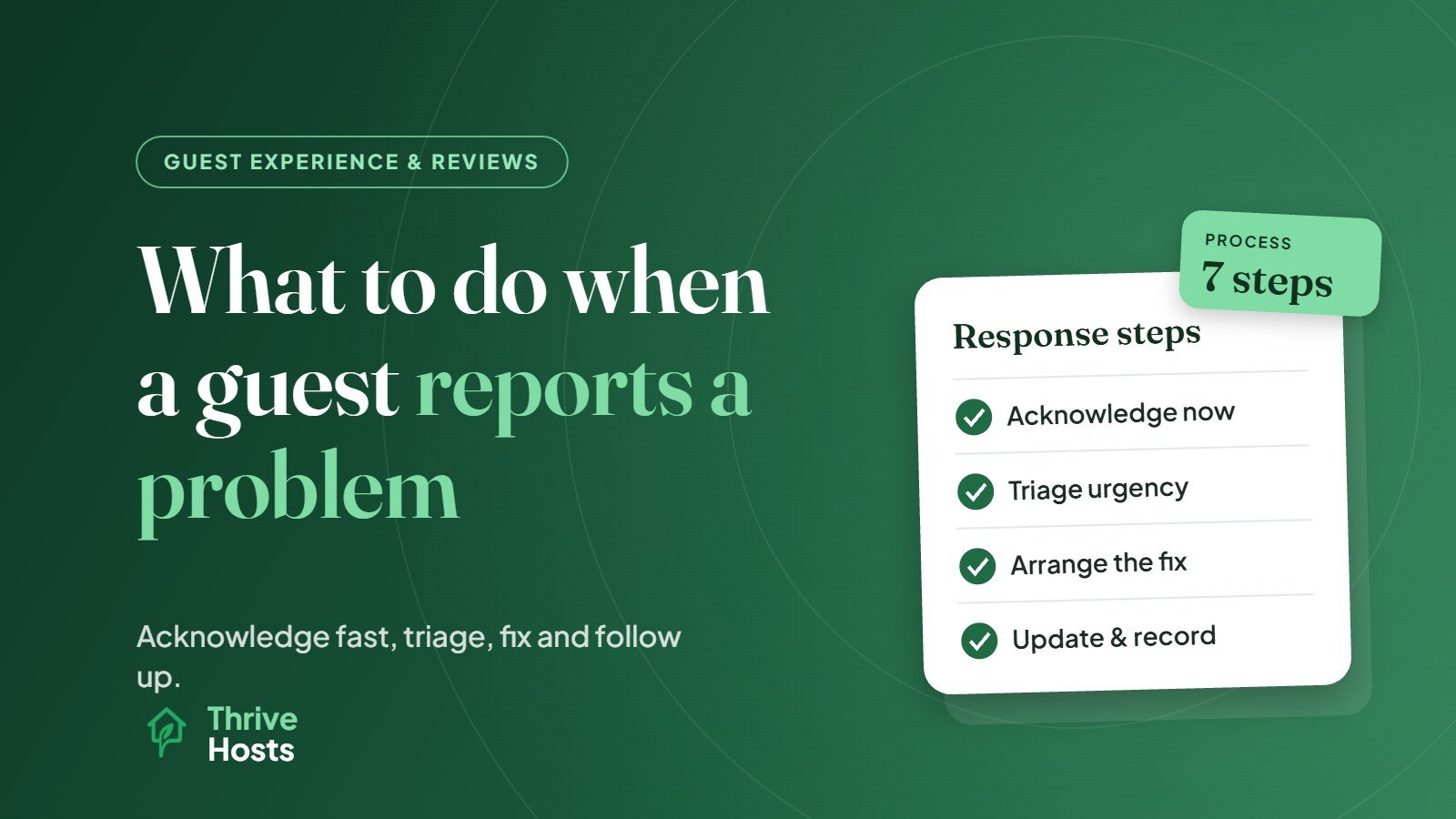
When a guest reports a problem during their stay, respond quickly, find out exactly what is wrong, decide how urgent it is, and tell the guest what will happen and when. Then arrange the fix through your approved local vendor or contact, follow up until it is confirmed resolved, and record what happened. Speed and clarity matter more than having an instant solution. A guest who knows a plumber is coming at 2pm is far calmer than one who has heard nothing.
This is also the moment where many reviews are won or lost, and where a fixable issue can become a refund request if it is ignored.
If you want a starting point for that first reply, the free guest issue response builder drafts an immediate message, a follow-up for after the fix and a short log note for your records.
Step 1: Acknowledge Immediately
Reply as soon as you see the message, even if you do not have an answer yet. Something like “Thanks for letting me know, I’m sorry about that. I’m looking into it now and will update you within 30 minutes” tells the guest they have been heard and gives you time to act.
Keep this communication inside Airbnb’s messaging, or your platform’s equivalent, so there is a record of what was reported and when.
Step 2: Get the Details
Ask the questions you need to understand the problem. When did it start? What exactly happens? Can they send a photo or short video? For appliances, which button or setting did they try? Many issues are resolved at this stage: a tripped fuse, a thermostat on the wrong setting, a TV on the wrong input, or Wi-Fi that needs a restart.
Have quick troubleshooting steps ready for the common problems, ideally in your house manual, so you can send them straight away.
Step 3: Triage by Urgency
Not every problem needs the same response. Sort issues into three groups:
Urgent: act now
Anything affecting safety, access or the basic habitability of the property: a lockout, a gas smell, a water leak, no heating in cold weather, no hot water, a power cut, a broken door lock or a security concern. For any immediate danger, the guest should contact local emergency services first. Then contact your vendor or local contact at once.
Important: fix today
Problems that significantly affect the stay but are not dangerous: a broken fridge, no Wi-Fi for a remote worker, a broken shower, a faulty oven, a missing key amenity.
Minor: fix soon or before the next guest
Inconveniences that do not stop the guest enjoying the stay: a broken lamp, a dripping tap, a slow drain, a missing utensil.
This triage tells you how fast to move and whether to send someone out of hours.
Step 4: Arrange the Fix
Contact the right person: your cleaner for missing supplies or cleaning issues, your handyperson for small repairs, or a licensed tradesperson for plumbing, electrical or gas problems. Confirm when they can attend, and arrange access with the guest. Never send someone to the property without telling the guest first.
This is where preparation pays off. Hosts with a list of approved local vendors, their after-hours availability and agreed call-out arrangements can move in minutes. Hosts without one spend the first hour searching for a plumber.
Step 5: Keep the Guest Updated
Tell the guest what is happening at each step: who is coming, when, and what to expect. If the fix will take longer than expected, say so and explain why. If something cannot be fixed during the stay, be honest about it and discuss options.
Update even when there is no news. Silence is what turns a manageable problem into frustration.
Step 6: Consider a Fair Gesture
If a problem has genuinely affected the stay, such as a day without hot water or a broken key amenity, a proportionate gesture can be appropriate: a partial refund for the affected nights, a late checkout, or a practical alternative. Process refunds through the platform. Never link a gesture to the guest’s review, which Airbnb’s review rules prohibit.
Also be aware that Airbnb’s guest protection treats serious issues seriously. According to Airbnb’s rebooking and refund guidance, guests are asked to notify the host within 72 hours of discovering a serious issue, such as heating not working in winter or a major advertised amenity missing. If the host cannot resolve it, Airbnb may help the guest rebook or provide a full or partial refund. Fast, effective responses give you the best chance of resolving the issue yourself.
Step 7: Close the Loop and Record It
Once the fix is done, confirm with the guest that everything is working. Then log the issue: what happened, when it was reported, who fixed it, how long it took and what it cost. Over time this record shows recurring problems, reliable and unreliable vendors, and maintenance that should be done proactively.
If the issue might affect the next guest, make sure your cleaner checks it during the turnover. And if a guest becomes difficult during the process, our guide on handling difficult Airbnb guests can help.
Prepare Before the Next Problem
- Keep a list of approved local vendors with after-hours contacts.
- Agree spending limits for urgent repairs that can be approved without waiting.
- Write troubleshooting steps for common issues into your house manual.
- Make sure someone can respond at any hour guests may need help.
- Keep a simple issue log for every property.
Our guide to common guest complaints covers the problems worth preventing in the first place.
Small hotels and motels without overnight reception can use the approach in handling guest issues without a 24-hour front desk.
Getting In-Stay Support Covered
Thrive Hosts handles in-stay issues as part of remote short-term rental operations support: guest communication, triage, coordination with your approved local vendors, follow-up until the fix is confirmed, and issue tracking with owner reporting. We do not perform repairs ourselves; we make sure the right local person is contacted quickly and the guest is kept informed.
You keep control of your property, accounts and spending decisions. We keep the response fast and organised.
Related reading: How the damage claim process works.
Explore STR operations support
See how we would handle guest-reported issues for your property, from first message to confirmed fix and owner report.
Explore STR Operations Support
Bruce J is the CEO of Thrive Hosts and leads the short-term rental team. He works on the operations and performance side of STR: guest communication, pricing and calendar discipline, turnovers, issue tracking and owner reporting across Airbnb, Vrbo and Booking.com. On the blog he writes practical, no-fluff guides for owners and operators who want their rentals to run more consistently.