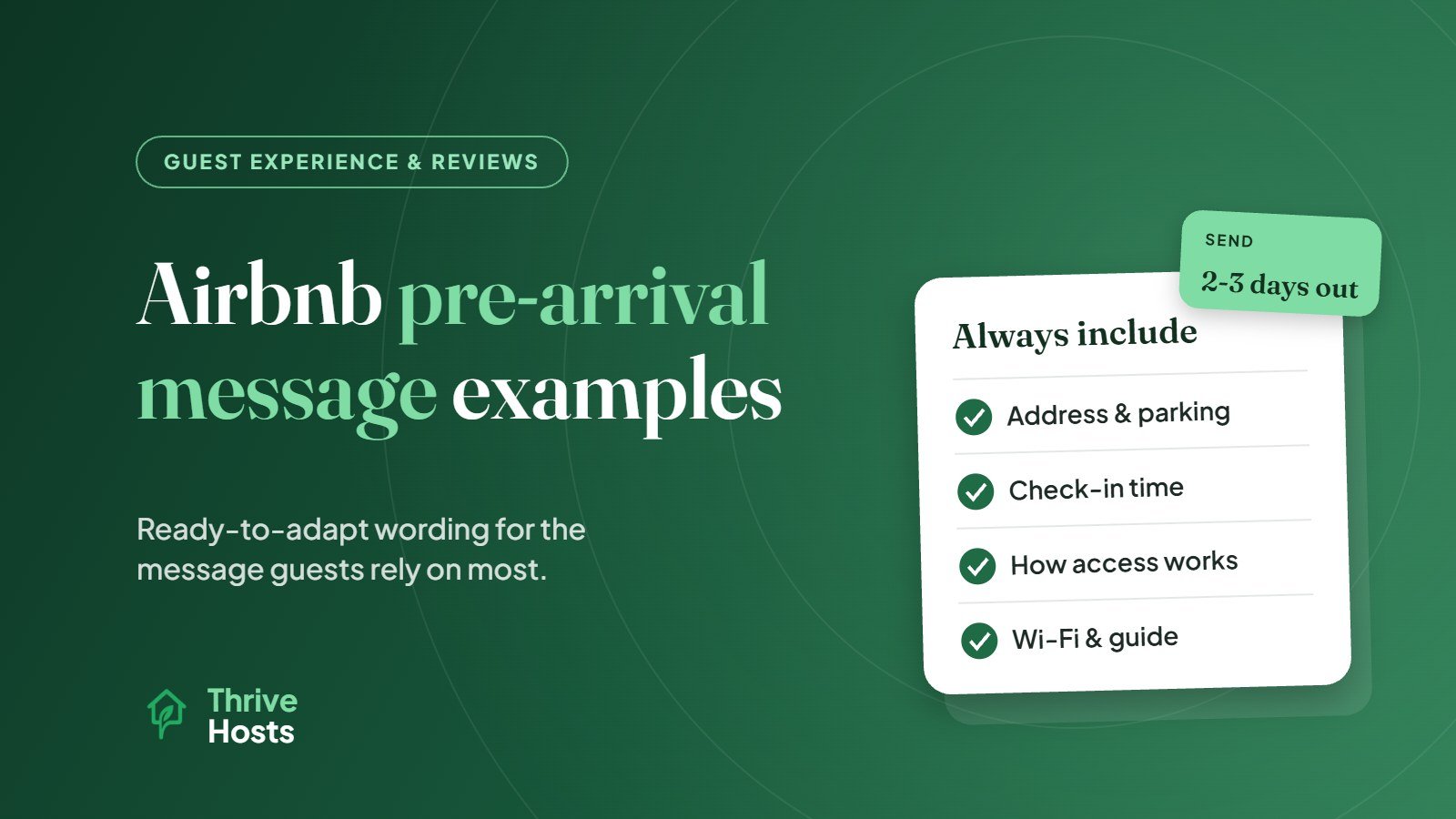
A good Airbnb pre-arrival message tells guests everything they need to plan their arrival in one easy-to-read message: the address and directions, parking, check-in time, how they will get in, Wi-Fi details or where to find them, a link to the house manual and anything unusual about the property. Most hosts send it two to three days before check-in, then follow up with a short check-in day message containing the door code or access details.
Below are examples you can adapt for different property types and situations. Replace the bracketed details with your own, and keep the wording natural.
What every pre-arrival message should include
- Greeting and dates so the guest knows the message is for their stay
- Address and how to find the property, including any tricky entrances
- Parking details, or where to park nearby if there is none on site
- Check-in time and what to do if they arrive earlier or later
- How access will work, with a note that codes will follow on the day if you send them separately
- Wi-Fi details or where to find them
- House manual or guidebook link
- A key house rule or two that guests often miss, such as quiet hours or no parties
- A question about arrival time, so you can plan
Keep the most important information near the top, and break the message into short sections so it reads well on a phone.
Example 1: Standard pre-arrival message
Hi [Name], we’re looking forward to hosting you from [date] to [date].
Here are the details for your arrival:
Address: [full address]. The entrance is [brief description, such as the blue door to the left of the shop].
Parking: [one space in the driveway / free street parking on X Street / nearest public car park].
Check-in is from [time]. We’ll send your door code on the morning of arrival.
Wi-Fi: [network name and password, or “details are in the house manual”].
House manual: [link]. It covers appliances, rubbish collection and local recommendations.
Could you let us know roughly what time you expect to arrive? If you have any questions before then, just message us here.
Example 2: Apartment building with access steps
Hi [Name], your stay at [property name] starts on [date], so here’s everything you’ll need.
The building is at [address]. Use the main entrance on [street]. The building door code is [code], and the apartment is on floor [number]; the lift is on the right.
Your apartment door uses a keypad. We’ll send that code on the day of arrival.
There is no parking at the building. The closest option is [car park name], about [time] on foot.
Check-in is from [time]. Quiet hours in the building are [hours], and our neighbours appreciate it.
Everything else, including Wi-Fi and appliance tips, is in the guide: [link]. Safe travels.
Example 3: House with parking or driveway rules
Hi [Name], we’re getting the house ready for you and wanted to share a few details before your trip.
Address: [address]. Please park in the driveway only, as street parking is restricted to residents.
Check-in is from [time] and checkout is at [time]. You’ll be using a smart lock; your personal code will arrive on the morning of check-in.
The house sleeps [number] guests. As a reminder, parties and events aren’t permitted, and quiet hours start at [time].
The house guide is here: [link]. Let us know your expected arrival time and if you need anything before you arrive.
Example 4: Late arrival
Hi [Name], thanks for letting us know you’ll be arriving late. That’s no problem, as check-in is self-service.
Your door code will arrive here on the morning of [date] and will work from [time] onwards. The porch light is on a timer, so the entrance will be lit.
If anything isn’t working when you arrive, message us here and [we / our team] will respond as quickly as possible.
Example 5: Remote or rural property
Hi [Name], a few tips to make your arrival easy, since the cabin is a little off the beaten path.
Navigation apps sometimes send guests down [road]. Please follow [directions] instead, or use this pin: [map link].
Mobile signal is patchy for the last few miles, so we recommend saving these instructions and the door code before you set off.
There are no shops near the cabin, so the last place to pick up groceries is [shop] in [town].
Check-in is from [time]. We’ll send the lockbox code on the morning of arrival.
For hotels, motels and inns with reception hours and late arrivals, see our hotel pre-arrival message examples.
Tips for better pre-arrival messages
Send it early enough to be useful but close enough to be remembered; two to three days before is common. Keep access codes for the day itself if they change between stays. Update the message whenever something changes at the property, such as new parking rules or a new appliance, and re-read your scheduled templates every few months. Clear pre-arrival information is one of the simplest ways to reduce arrival-day problems, as covered in our guide to better check-in instructions.
For where this message fits in the full sequence, see what messages Airbnb hosts should send guests and our broader Airbnb guest messaging guide.
Want your guest messages written and sent for you?
Thrive Hosts manages Airbnb guest communication remotely, including pre-arrival and check-in messages tailored to your property, plus responses to guest questions throughout the stay.
See How Airbnb Co-Hosting Works
Bruce J is the CEO of Thrive Hosts and leads the short-term rental team. He works on the operations and performance side of STR: guest communication, pricing and calendar discipline, turnovers, issue tracking and owner reporting across Airbnb, Vrbo and Booking.com. On the blog he writes practical, no-fluff guides for owners and operators who want their rentals to run more consistently.