Every small hotel owner eventually does the same sum in their head: a guest books through an OTA, the commission comes off, and the question is how many of those guests would have booked direct if the direct route were easier. This guide gives you a way to work that out with your own numbers instead of a rule of thumb.
Start with what a booking really costs you
Commission is the visible part. Each OTA sets its own rate, and rates differ by property, region and programme, so check your extranet or contract rather than assuming a number. Take the percentage you actually pay and apply it to the room revenue of a typical stay.
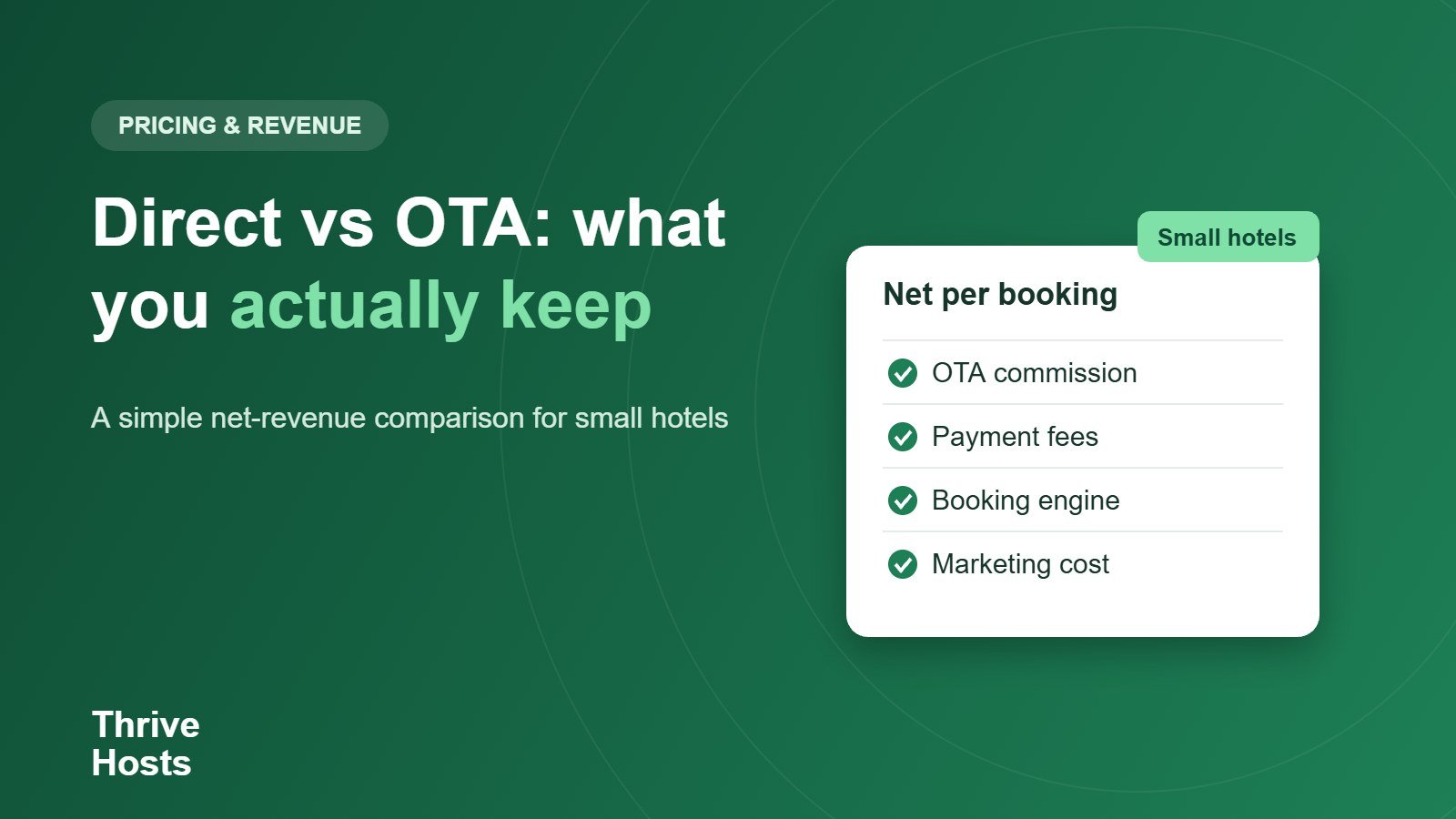
Direct bookings are not free either. Booking engine fees, payment processing, any ad spend that drives visits to your site and the staff time spent on enquiries all belong in the sum. A fair comparison puts both sides on the same footing: what you keep from a stay after every cost attached to winning it.
A simple way to compare the two
- Pick one room type and one typical length of stay.
- Work out the room revenue for that stay.
- Subtract the OTA commission you pay on it.
- Separately, subtract your direct costs: payment fees, booking engine fees and any marketing you can tie to direct bookings.
- Compare what is left in each case.
If you want to skip the arithmetic, the Booking.com commission calculator shows what a given commission rate takes from a booking, and the direct booking savings calculator lets you test how much you keep if some share of guests moves to your own channel.
Where OTAs still earn their cut
OTAs bring guests who would never have found a small property on their own. For a new or quiet hotel, that visibility is often the reason it has occupancy at all. Paying commission for a guest you would not otherwise have met is a reasonable trade.
The calculation changes for guests who already know you: past guests, people who found you through a recommendation, and anyone who searches your name. Those are the bookings where an OTA commission is most likely to be avoidable.
Practical ways to shift repeat guests direct
- Make sure your website shows live availability and a clear booking route, not just a phone number.
- Put your direct booking link in confirmation messages and pre-arrival emails, in a way that follows each OTA’s own rules on how you may contact guests.
- Offer something real for booking direct, such as flexible check-in times when available, a small upgrade or a clearly better cancellation term, rather than inventing a discount you cannot sustain.
- Keep guest details from stays you own the relationship for, and ask permission before you market to them.
Check each OTA’s partner terms before you do any of this. Some restrict how you can advertise rates or point guests away from the platform, and the rules vary by agreement.
Keep the channels healthy while you shift
Moving some demand direct does not mean switching OTAs off. Over-reliance on any single source is a risk, and so is losing ranking by pausing a channel without a plan. Keep inventory and rates in sync across everything you use; our guide to small hotels on multiple OTAs covers that side, and managing Booking.com reservations covers the day-to-day.
What to track
Review it monthly: the share of bookings by source, the average net revenue per booking by source, and how many direct bookings come from returning guests. If the direct share rises and net revenue per booking holds, the approach is working. If direct enquiries pile up with no conversions, the problem is usually the booking path, not the pricing.
Want a second pair of eyes on your channel mix?
We work remotely with boutique hotels and motels on OTA inbox management, rate hygiene and direct-booking setup. We can review how your bookings split by source and suggest what to change first.
See our hotel and motel support
Bruce J is the CEO of Thrive Hosts and leads the short-term rental team. He works on the operations and performance side of STR: guest communication, pricing and calendar discipline, turnovers, issue tracking and owner reporting across Airbnb, Vrbo and Booking.com. On the blog he writes practical, no-fluff guides for owners and operators who want their rentals to run more consistently.