Cleaning fees cause more argument between hosts and guests than almost any other price element, and more quiet losses for hosts than most realise. Set too high, the total price puts off bookings. Set too low, you pay out of the nightly rate every time someone leaves, and short stays can make that expensive quickly.
There is no universal figure, but there is a straightforward way to work out what your property needs.
Start with what a turnover actually costs
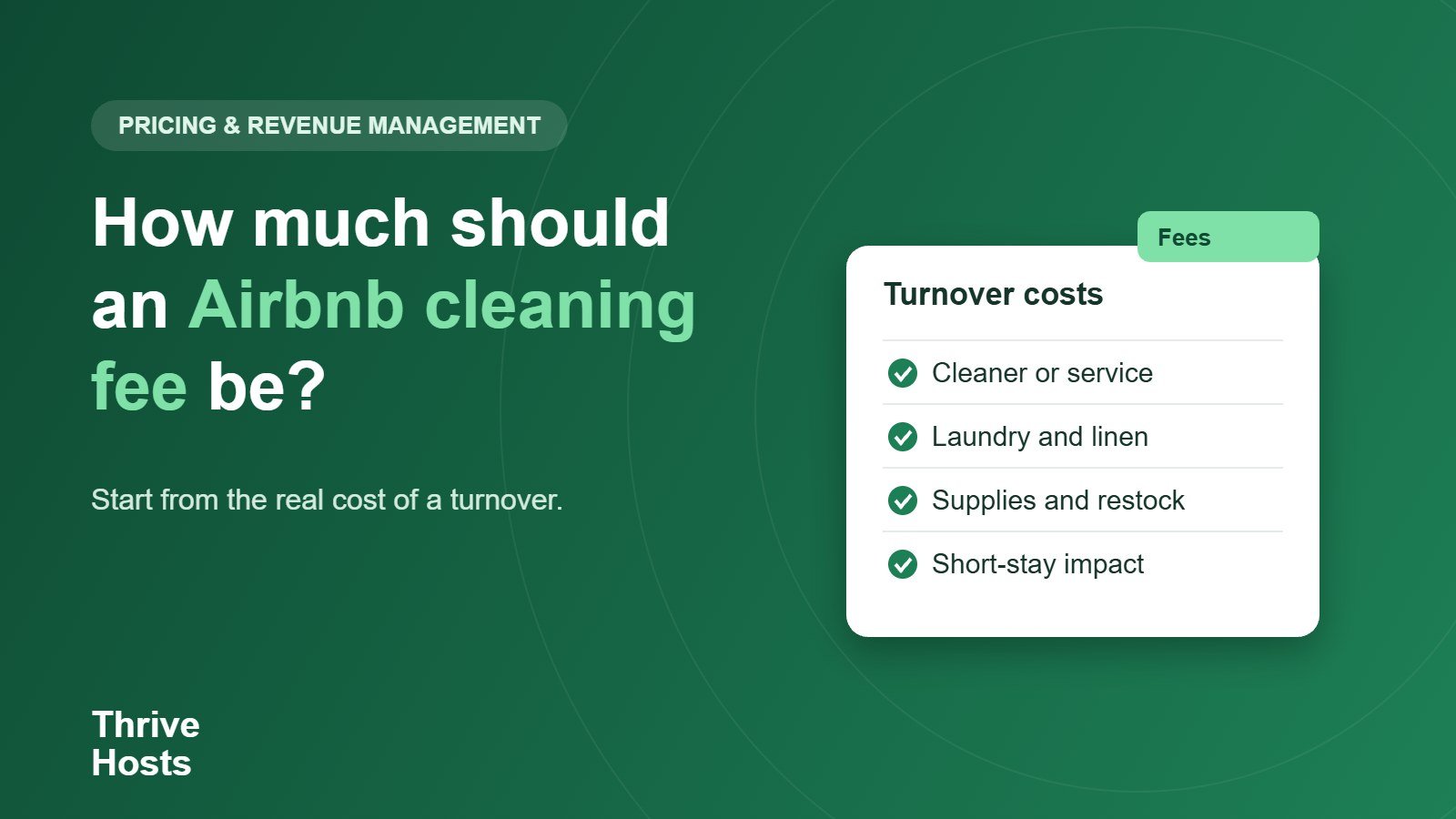
Add up every cost of one turnover, not just the cleaner’s invoice. That includes the cleaner or cleaning company, laundry or linen service, consumables such as soap, toilet paper, bin liners and coffee, and any restocking or minor repairs you handle every stay. If a co-host or manager charges a per-turnover coordination fee, include it. Some owners also add a small amount for wear and tear, though it is better to price that into the nightly rate.
Then compare the total with what the cleaning fee collects. If a turnover costs 85 and the fee is 60, the 25 difference comes from the nightly rate. On a one-night stay that can erase most of the profit. The cleaning fee calculator helps run this comparison for different stay lengths.
Why stay length changes the answer
A cleaning fee is charged once per stay, while the nightly rate is charged per night. For a seven-night booking, a 100 cleaning fee adds about 14 to each night. For a one-night booking it adds 100 to a single night. Short stays therefore feel the fee most, and long stays barely notice it. If your calendar is full of one- and two-night bookings, the fee needs to cover costs fully and your minimum stay may be worth reviewing. Our guide on minimum stay strategy shows how to balance both.
Fees, refunds and cancellations
Airbnb’s Help Center says cleaning fees are fully refunded during the free-cancellation period, and after that they count as part of the nightly price, with refunds following your policy. It also says the host service fee is calculated on the nightly price plus optional fees you add, such as cleaning or pet fees, so a higher cleaning fee also increases the fee Airbnb takes. Both points affect the net amount, so use the Airbnb host fee calculator to see what you keep. For more on cancellations, see which Airbnb cancellation policy to choose.
Do not hide costs in the wrong place
Some hosts set a very low cleaning fee and raise the nightly rate to compensate. That can work for long stays and weaken the listing for short ones. Others do the opposite, with a high fee and a modest nightly rate, which shows a good headline price but a big total. Neither is wrong. What matters is that the structure matches the guests you want. If most of your stays are short, a fee that covers costs is more honest and more reliable. If most are long, you can lean toward the nightly rate.
Check against comparable listings
Look at similar properties in your area, with similar size and amenities, and compare the total price for a typical stay length, not just the fee. If your total is much higher than comparable listings for no clear reason, adjust either the fee or the nightly rate. Remember that the guest compares totals.
Changing the fee
Review the figure when your cleaner raises their rate or your costs change. Many owners forget to update the fee for years while their cleaner’s price rises, which gradually turns into a pay cut. If the property has a bigger cleaning requirement for large groups, pets or longer stays, consider whether extra-guest or pet fees are the better fix than a high base fee.
Cleaning-fee checklist
- Add up the full cost of a turnover, including laundry and supplies.
- Compare it with the fee for one-night, three-night and week-long stays.
- Check how the fee is treated under your cancellation policy and Airbnb’s fee base.
- Compare your total price with similar listings.
- Update the fee whenever costs change.
Related reading: How the host service fee works.
Want to check whether turnovers are costing you money?
Thrive Hosts reviews pricing structure, turnover costs and calendar patterns, and coordinates cleaners remotely so costs are tracked and reported. See how our STR operations support works for owners who want to understand their margins.
Explore STR operations support
Bruce J is the CEO of Thrive Hosts and leads the short-term rental team. He works on the operations and performance side of STR: guest communication, pricing and calendar discipline, turnovers, issue tracking and owner reporting across Airbnb, Vrbo and Booking.com. On the blog he writes practical, no-fluff guides for owners and operators who want their rentals to run more consistently.