A minimum nightly rate is the price below which you would rather leave the night empty. Most hosts either never set one, so last-minute discounts and automated pricing can take the rate to a level that loses money, or they set one by feel, so it sits too high to ever be useful. A cost-based floor is more reliable, and it only takes a few numbers to build.
This guide shows how to calculate it, and how it differs from the minimum price you set in a pricing tool or Airbnb’s own settings.
What the floor is and is not
The floor is a cost-based number, not a market-based one. It answers “what do I need to charge to cover what this night costs me and still earn something?” It does not tell you what the market will pay on a given night. In a strong week your price will sit far above it. In a weak midweek in February it is the line you refuse to cross. Keeping these two ideas separate matters, because the floor protects you from your own discount rules.
The costs to include
Start with the costs that rise with each booking, then add a share of the costs that do not.
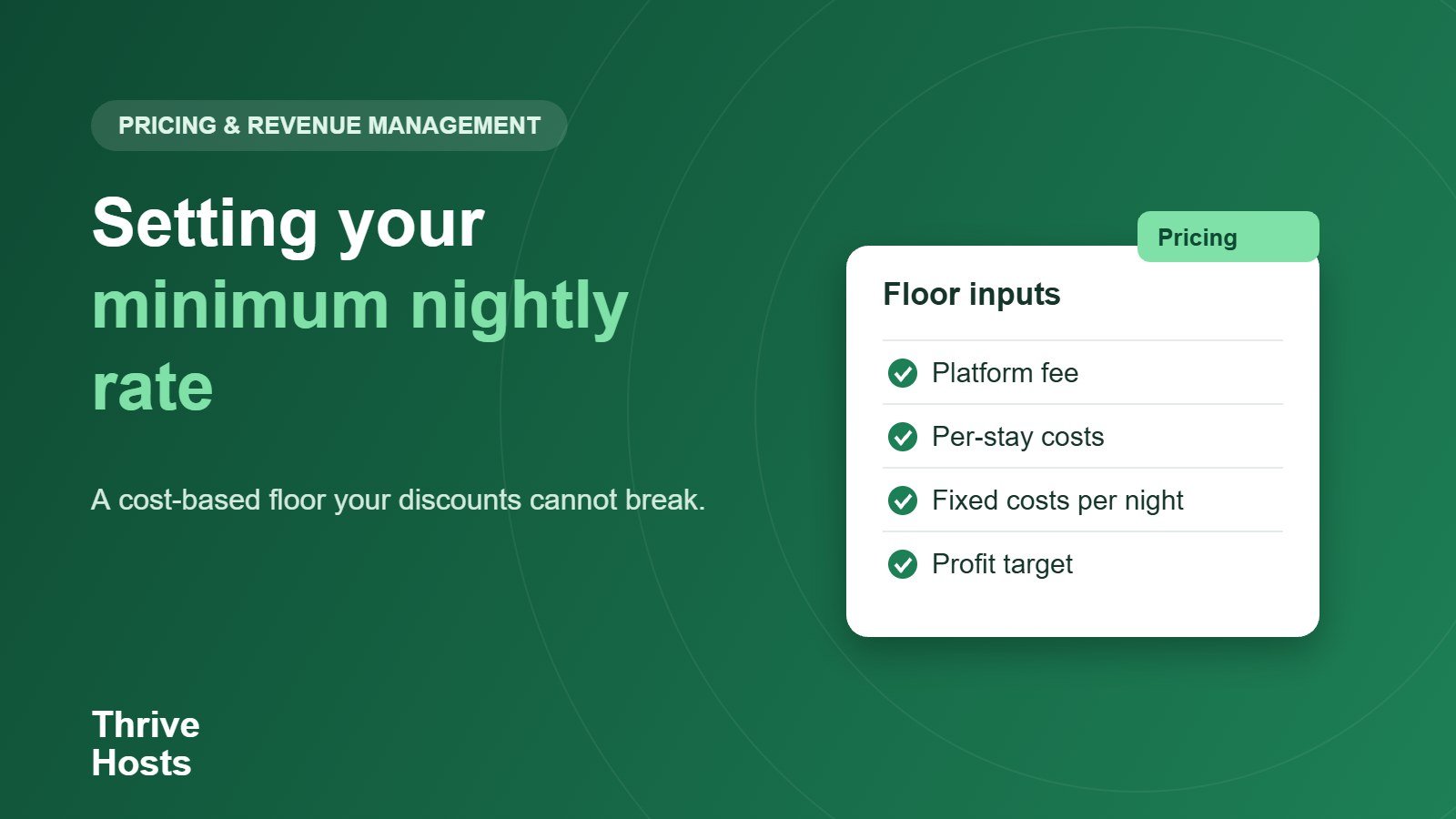
- Platform fee: Airbnb’s Help Center describes a single 15.5% host fee in 2026, calculated on the nightly price plus optional fees such as cleaning or pet fees, with exceptions in some countries. Check your own fee in a booking breakdown.
- Per-stay costs not covered by the cleaning fee: laundry, supplies, welcome items, extra wear on the property and any per-booking management or co-hosting fee.
- Fixed monthly costs: mortgage or rent, utilities, internet, insurance, software subscriptions and any retainer, spread across the nights you realistically expect to sell.
- Your target profit per night, even a small one.
A simple way to calculate it
Take the costs you need to recover per night, divide by one minus the platform fee, and you get the lowest price that covers them. As an illustration only, suppose fixed costs are 1,200 a month, you expect to sell 18 nights, per-stay costs not covered by the cleaning fee average 20 per night and you want a profit of 10 per night. Fixed costs per sold night are about 67, so you need roughly 97 to cover costs and profit before fees. Divide by 0.845 and the floor is about 115. Your numbers will differ, and the minimum nightly rate calculator does the arithmetic for you, with the Airbnb host fee calculator to see what a booking nets after fees.
The fixed-cost share depends on how many nights you expect to sell. If you can only sell 12 nights in a slow month, the same fixed costs are spread more thinly and the floor rises. Use a realistic estimate of occupancy for the season, not the optimistic figure.
Where to apply it
Once you have a number, set it in the places that can lower your price automatically: the minimum price in a dynamic pricing tool, the smart pricing range, and any last-minute or weekly discount rules. Remember that discounts stack, so a base price at the floor with a 10% weekly discount is already below it. Our guides on last-minute discounts and dynamic pricing discuss how those rules interact.
When to go below it
Sometimes it makes sense to accept less than the floor. A one-night gap between two longer bookings may be worth filling at a lower price if the cleaning is already scheduled and the extra cost is small. Marginal costs matter more than full costs in those cases. The important thing is that it is a decision, not an accident, and that you know how far below the floor you are going and why.
Review it when costs change
A floor goes stale. Update it when your cleaner raises rates, insurance renews, the mortgage rate changes or you add a software subscription. A quick review each quarter keeps the number honest. For the wider approach to setting rates, see how to price an Airbnb property.
Floor checklist
- List per-stay costs not covered by the cleaning fee.
- Estimate fixed monthly costs and realistic nights sold.
- Add a small profit target.
- Divide by one minus the platform fee.
- Set the result as the minimum in your pricing tool and discount rules.
- Update it when costs change.
Related reading: Airbnb fall 2026 update for hosts.
Want pricing guardrails you do not have to monitor?
Thrive Hosts supports pricing and calendar decisions remotely, including minimum rates, seasonal adjustments and gap-night strategy, with the owner approving the rules. See how our Airbnb co-hosting service handles pricing support.
Explore Airbnb co-hosting
Bruce J is the CEO of Thrive Hosts and leads the short-term rental team. He works on the operations and performance side of STR: guest communication, pricing and calendar discipline, turnovers, issue tracking and owner reporting across Airbnb, Vrbo and Booking.com. On the blog he writes practical, no-fluff guides for owners and operators who want their rentals to run more consistently.