A cancellation policy decides who carries the risk when plans change. Set it too loose and you may lose nights you cannot resell. Set it too tight and some guests will pick a competitor with a more forgiving option. The right choice depends less on personal preference than on how quickly you can rebook a cancelled stay.
The standard options for stays of up to 27 nights
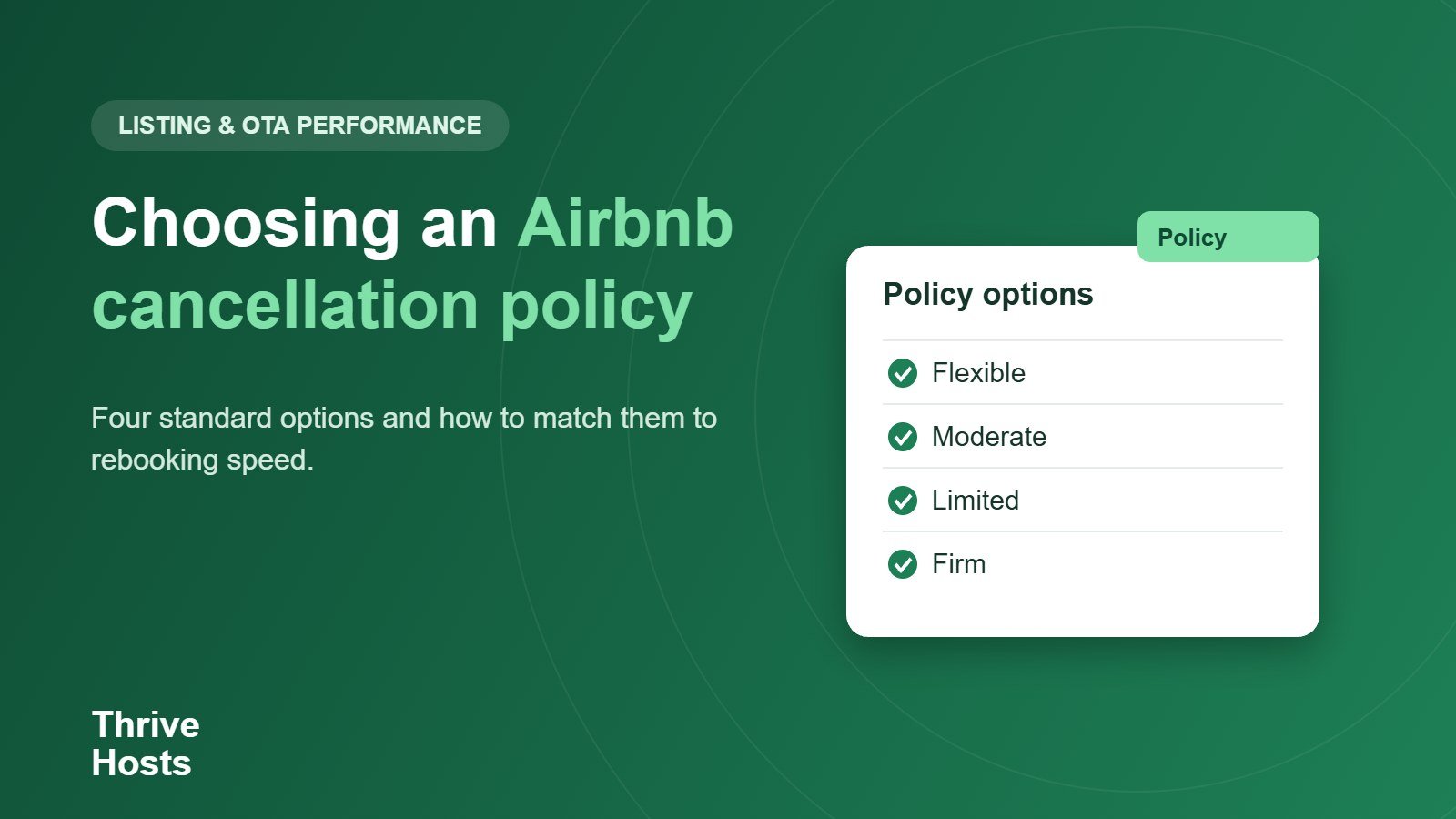
Airbnb’s Help Center lists four standard policies for stays of 27 or fewer consecutive nights, and all of them give guests a full refund if they cancel within 24 hours of booking, provided the cancellation is at least seven days before check-in.
- Flexible: full refund up to 24 hours before check-in. Later cancellations pay the host the first night, or the nights stayed plus one extra night if the guest had checked in.
- Moderate: full refund up to five days before check-in. After that, the host is paid for nights stayed plus one extra night and 50% of the unspent nights.
- Limited: full refund up to 14 days before check-in. Cancellations seven to 14 days out pay the host 50% of all nights, and inside seven days the host is paid 100%.
- Firm: full refund up to 30 days before check-in. Cancellations seven to 30 days out pay 50% of all nights, and inside seven days 100%.
You can also add a non-refundable option to a standard policy. Guests who choose it get a stricter policy in exchange for a discount, typically about 10% off your base price, and if they cancel you keep the full payout.
Long stays have separate policies
For stays of 28 nights or more, Airbnb uses long-term policies: Firm and Strict. Both pay the host for nights spent plus 30 additional nights after the free window closes, with Strict offering a much shorter free-cancellation period. If you take monthly guests, review these separately and check the terms against your cleaning and turnover needs. A weekly or monthly discount often goes hand in hand with this decision.
What happens to the cleaning fee
Airbnb says cleaning fees are fully refunded during the free-cancellation period. After that, they count as part of the nightly price and refunds follow your policy. Bookings made before April 21, 2025 follow an older rule, under which cleaning fees were refunded if the guest cancelled before check-in, regardless of policy. Keep that in mind if you have old reservations on the calendar.
How Airbnb suggests choosing
Airbnb’s guidance is to start with the most flexible policy that supports your business and change it if needed. In general, Flexible suits low season, high-demand periods when you are confident of rebooking, or competitive locations. Moderate discourages last-minute cancellations and appeals to business travellers. Limited works if you can handle cancellations with at least two weeks’ notice, and Firm suits properties that need 30 days to rebook or are in demand all year.
Match the policy to how you rebook
A practical way to decide is to ask how many days it takes to resell a cancelled stay. If you typically rebook within a few days at a similar price, a flexible or moderate policy costs little. If your property sits empty at short notice, as many rural or niche properties do, a stricter policy protects revenue. Last-minute demand depends on your pricing too, so see our guides on last-minute discounts and gap nights to judge how realistic a quick rebooking is.
You can also vary the policy over time. Many hosts use flexible terms in slow months to attract bookings and firmer terms for peak weeks and holidays, when a cancelled stay is hard to replace and demand is high. Airbnb says you can change your policy at any time.
Think about the guest too
Stricter policies reduce cancellations but can lower conversion, especially for guests booking far ahead. If your occupancy is already strong, you can afford to be firmer. If you are building bookings on a new listing, a flexible policy removes one more reason to hesitate.
Quick decision guide
- Estimate how long it takes to rebook a cancelled stay.
- Start with the most flexible policy that fits your business.
- Use stricter terms in peak weeks and for long stays.
- Consider a non-refundable option for guests who want a discount.
- Review cleaning fees and any older bookings under previous rules.
- Revisit the setting each season.
Unsure which policy fits your calendar?
Thrive Hosts reviews listing settings, calendar patterns and cancellations and recommends what to change first. See how our listing optimization service can help you set the terms that match your occupancy.
Get your listing reviewed
Bruce J is the CEO of Thrive Hosts and leads the short-term rental team. He works on the operations and performance side of STR: guest communication, pricing and calendar discipline, turnovers, issue tracking and owner reporting across Airbnb, Vrbo and Booking.com. On the blog he writes practical, no-fluff guides for owners and operators who want their rentals to run more consistently.