High occupancy feels like success. The calendar is full, the property is busy and there is no obvious problem to fix. But a fully booked short-term rental can still be underperforming, because occupancy only measures how many nights sold, not what they sold for or what each stay cost to deliver. A property at 90% occupancy can earn less, and keep less, than a similar one at 70% with stronger rates.
If your calendar is consistently full, it is worth asking whether you are leaving money on the table.
The underpricing problem
The most common reason for very high occupancy is a price that is lower than the market will bear. Guests are good at spotting value. If your property offers more than similar listings at the same price, or the same at a lower price, it will fill quickly. That is not necessarily a sign of a well-run listing; it can be a sign that the price is doing all the work.
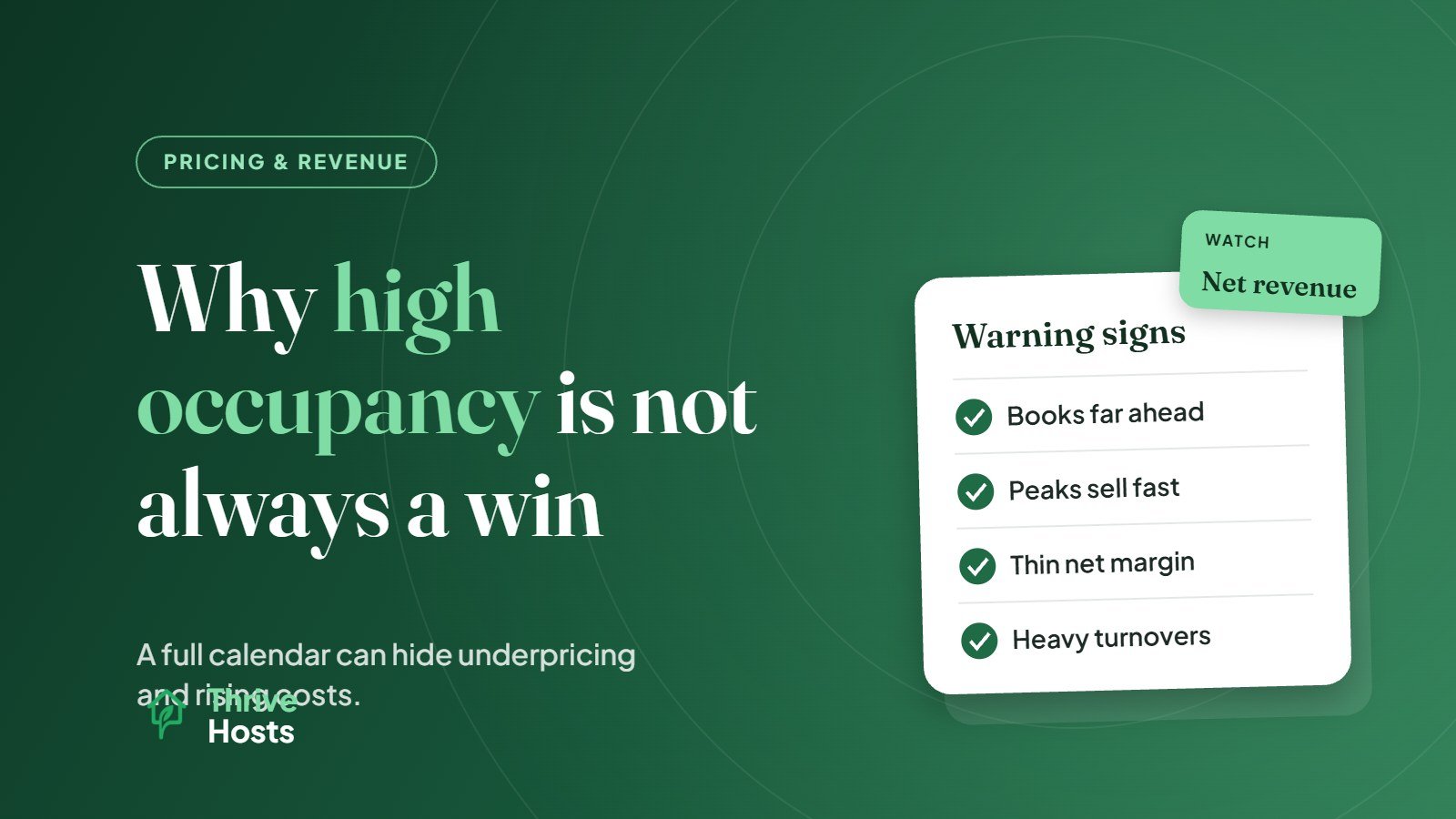
Signs that high occupancy may be masking underpricing include:
- Dates booking much further in advance than in comparable listings
- Peak weekends and event dates filling quickly at your normal rate
- Very few unbooked nights, even in shoulder or low season
- Guests frequently commenting on how good the value is
- Similar nearby listings charging noticeably more and still filling
Each booking has a cost
Every stay brings costs that do not depend on the nightly rate: cleaning, laundry, consumables, platform fees, utilities and guest communication. Short stays make this worse, because those costs are spread across fewer nights.
Consider a simple example. If cleaning, laundry and supplies cost 80 per turnover, a two-night stay at 100 per night leaves 120 after those costs, before platform fees and fixed costs. A three-night stay at 130 per night leaves 310. The first scenario creates more turnovers, more workload and more wear for less income. Across a busy year, the difference adds up.
Workload and wear are real costs too
High occupancy also means more check-ins, more messages, more cleaner coordination and more chances for something to go wrong. Furniture, linens, appliances and finishes wear out faster. These costs do not always show in a monthly revenue figure, but they show up in maintenance bills, replacement cycles and in the time spent running the property. Our article on handling maintenance issues in a short-term rental touches on how that wear accumulates.
Look at RevPAR and net revenue
Rather than chasing occupancy, track revenue per available night (RevPAR), which combines occupancy and average daily rate, and then look at net revenue after per-stay costs. Our explainer on occupancy vs ADR covers how these metrics work together.
A strategy that lowers occupancy slightly while lifting ADR can increase both RevPAR and net revenue, while reducing turnovers.
How to test whether you are underpriced
You do not need to make a dramatic change to find out. A few low-risk tests include:
- Raise prices on dates far in the future first. If they still book at a similar pace, your previous rates were likely too low.
- Increase peak and event rates. These are the dates where underpricing costs the most.
- Reduce or remove discounts on dates that do not need them.
- Review minimum stays on busy periods to reduce short, high-cost bookings.
- Compare against similar listings for the same dates, looking at total price including fees.
Make one or two changes at a time and give them a few weeks before judging the result. Our guide on how often to change Airbnb prices can help with timing.
The right occupancy level is not 100%
There is no universal target occupancy, but a calendar that is almost always completely full is often a signal to test higher rates rather than a goal to aim for. The aim is the best combination of rate and occupancy for your property, after costs, with a workload you can sustain. For more on finding that balance, see Airbnb pricing strategy for hosts.
Busy calendar, but revenue feels flat?
Thrive Hosts reviews pricing, stay rules and performance for STR owners remotely, looking at ADR, RevPAR and per-stay costs, not just occupancy. We help you test changes carefully, and you keep control of your rates.
Explore Pricing & Revenue Support
Bruce J is the CEO of Thrive Hosts and leads the short-term rental team. He works on the operations and performance side of STR: guest communication, pricing and calendar discipline, turnovers, issue tracking and owner reporting across Airbnb, Vrbo and Booking.com. On the blog he writes practical, no-fluff guides for owners and operators who want their rentals to run more consistently.