Last-minute Airbnb discounts make sense when a night is likely to go unbooked otherwise and the discounted rate still covers your costs for that stay. They tend to work in low season, mid-week, in markets with plenty of short-notice travel and for properties with low turnover costs. They make less sense when demand is strong, when your market books late anyway at full price, or when the discount trains you into routinely underpricing dates that would have filled.
The question is not whether to discount, but which nights, by how much and how close to the date.
How last-minute discounts work on Airbnb
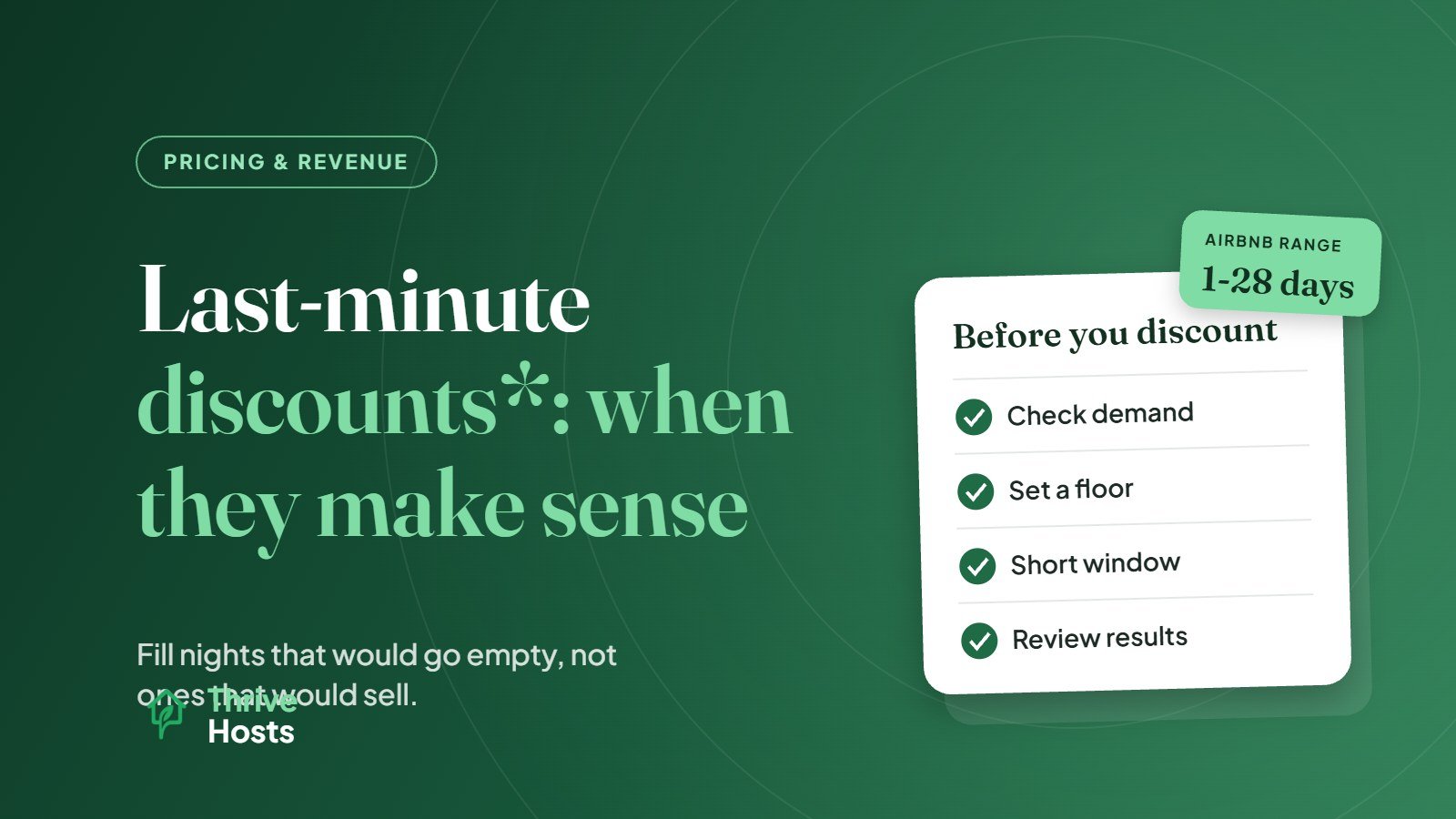
Airbnb’s pricing settings include a last-minute discount that applies to bookings made between 1 and 28 days before check-in. You choose the percentage and the window. Hosts can also set custom prices for individual nights or create time-limited promotions, and dynamic pricing tools, including Airbnb’s Smart Pricing and third-party tools, often reduce prices automatically as dates approach.
Each method reaches the same goal in a different way. The built-in discount is simple but applies to every unbooked night in the window. Custom pricing and dynamic tools allow more control over which nights are reduced and by how much.
When last-minute discounts help
Low-demand periods. In off-season weeks, a night left empty earns nothing. A reasonable discount that attracts a booking is usually better than a vacant night, as long as it covers the turnover.
Markets with late bookers. Some markets, such as cities with business or event traffic, or drive-to weekend destinations, see a large share of bookings in the final days. A small, well-timed reduction can help capture that demand.
Isolated open nights. A single unbooked weeknight between two stays is unlikely to sell at full price at short notice. Discounting it, alongside a shorter minimum stay, can fill it. Our guide on handling gap nights covers this.
New listings. A listing building its first reviews may benefit from short-notice discounts to generate bookings, alongside Airbnb’s new listing promotion.
When they work against you
When demand is already strong. If your peak season or event dates usually fill close in, discounting them gives away revenue you would have earned anyway.
When the discount window is too long. A 28-day window in a market where most guests book a month or more ahead can discount nights that were never at risk.
When the discounted rate does not cover the stay. If cleaning, laundry and supplies cost a large share of the nightly rate, a deep discount on a one-night stay may produce little or no profit.
When it becomes a habit. Regular deep discounts can mask a base price that is too high in the first place. If most of your nights only sell after discounting, the real issue is the starting price, not the timing. Our article on signs your Airbnb pricing strategy needs work explains how to spot this.
How to set last-minute discounts deliberately
- Know your booking window. Look at how far ahead your bookings usually arrive. Set any discount window inside the period when unbooked nights genuinely become at risk.
- Set a price floor. Decide the lowest rate you will accept for a night after turnover costs, and never discount below it.
- Start small. A modest discount close to the date is often enough. Increase it only if the data shows it is needed.
- Separate high- and low-demand dates. Avoid applying the same discount to a quiet Tuesday and a busy Saturday.
- Pair discounts with stay rules. A discount on a night that cannot be booked because of your minimum stay does nothing. Lowering the minimum close to the date often matters more than the price.
- Review results. Check whether discounted nights actually booked, and what they earned after costs.
Discounts are part of the broader pricing picture
Last-minute discounts are one tool within your overall pricing strategy, not a fix for every slow period. They work best when your base pricing, seasonal rates and minimum stays are already sensible, and discounting is used to fill the nights that remain. For the bigger picture, see Airbnb pricing strategy for hosts and our comparison of dynamic vs manual Airbnb pricing.
Not sure whether your discounts are helping?
Thrive Hosts manages Airbnb pricing remotely, including short-notice pricing, discount rules and minimum stays, and reviews what discounted nights actually earn. You stay in control of your pricing limits.
Explore Pricing & Revenue Support
Bruce J is the CEO of Thrive Hosts and leads the short-term rental team. He works on the operations and performance side of STR: guest communication, pricing and calendar discipline, turnovers, issue tracking and owner reporting across Airbnb, Vrbo and Booking.com. On the blog he writes practical, no-fluff guides for owners and operators who want their rentals to run more consistently.