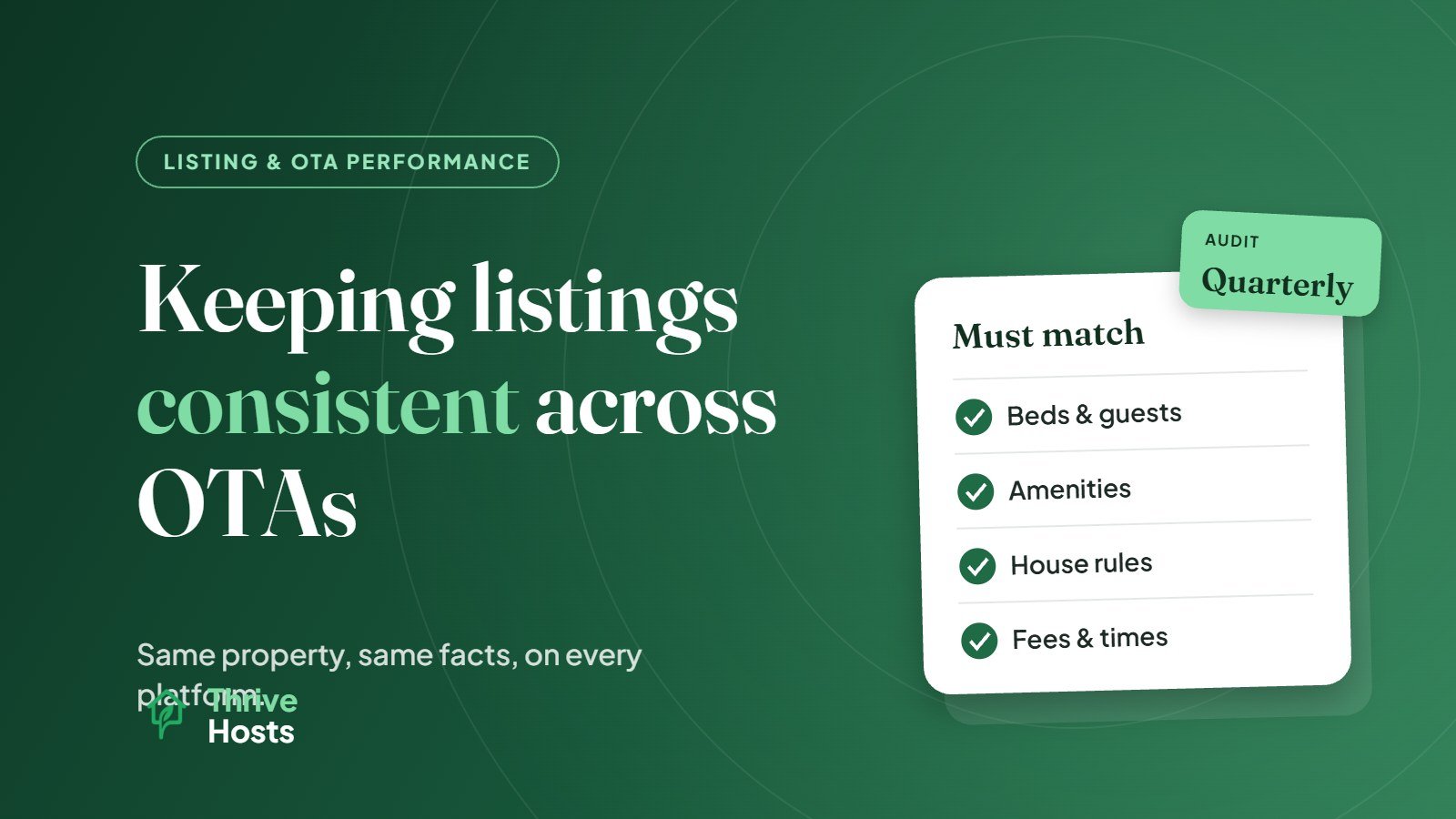
Keeping listings consistent across Airbnb, Vrbo and Booking.com means making sure guests see the same core facts about your property on every platform: the same photos and room details, the same amenities, the same house rules and policies, the same fees and the same availability. Prices and some settings may legitimately differ between platforms. What should not differ is the description of what the guest is actually getting.
Inconsistency is one of the quieter problems in multi-channel STR operations. It rarely causes a single dramatic failure, but it leads to confused guests, avoidable complaints, disputes over house rules and reviews that mention things not matching the listing.
Why listings drift apart
Most owners set up their second and third listings carefully. The drift happens afterwards. A new coffee machine gets added to the Airbnb listing but not Vrbo. Pet policy changes on one platform. The hot tub is out of action and only one listing says so. Check-in time moves from 3 pm to 4 pm on Booking.com because of a turnover issue and never gets updated elsewhere.
Each platform also has its own structure and fields, so content that was copied once does not automatically stay aligned. Over time, three listings that started identical become three slightly different descriptions of the same home.
Create a single master listing document
The most effective fix is a master listing document that sits outside the platforms. It holds the approved version of everything guests see: title variations, full description, room-by-room details, bed configuration, amenities, house rules, check-in and checkout times, fees, cancellation approach, safety information and photo order.
When something changes, the master document changes first, and then each platform is updated from it. This sounds like extra work, but it is far faster than trying to remember which platform says what. It also makes it easy to hand listing updates to someone else.
What must stay identical
Some information should match exactly on every platform:
- Sleeping arrangements and maximum guests, including bed types per room
- Amenities, especially high-impact ones like parking, Wi-Fi, air conditioning, pool, hot tub and pet policy
- House rules, including quiet hours, parties, smoking and extra guests
- Check-in and checkout times and how access works
- Mandatory fees, such as cleaning fees and any local taxes, set up correctly in each platform’s fee fields
- Disclosures, such as stairs, shared spaces, noise, cameras or ongoing building work
- Availability, kept in sync through a channel manager, PMS or reliable calendar connection
What can reasonably differ
Other elements can be adapted per platform as long as they do not misrepresent the property:
Titles and descriptions can be adjusted to fit each platform’s format and character limits. Booking.com relies more on structured fields; Airbnb and Vrbo allow more narrative.
Pricing may differ to reflect each platform’s fee structure, as long as you are not in breach of any platform terms you have agreed to.
Cancellation policies do not always map one-to-one because each platform offers different options. Choose the closest equivalent and make sure the practical outcome for guests is similar.
Photo order can be tuned per platform, but the set of photos should represent the same property, taken at the same time.
Use your tools to reduce manual updates
A channel manager or PMS can push availability, rates and in some cases content to multiple OTAs from one place. That reduces the number of manual edits and the chance of one platform being left behind. Content syncing is not always complete, though, so check what your system actually controls and what still needs to be edited directly on each platform. Our guide on managing multiple booking channels from one system covers the setup in more detail.
Run a regular consistency audit
Even with good systems, a periodic manual check is worth doing. Once a quarter, and after any significant change to the property, open each listing side by side and compare it with the master document. Check guest count, beds, amenities, rules, times, fees and the first several photos. Look at recent reviews on each platform too; comments like “the listing said…” often point to a mismatch.
Consistency supports every other part of the listing
Accurate, consistent listings reduce pre-booking questions, check-in confusion and disputes. They also make it easier to judge each platform’s performance fairly, because differences in bookings are more likely to come from the platform and its audience rather than from the listing itself. If you are still deciding whether multi-channel listing is right for your property, see whether to list your STR on multiple OTAs.
Managing listings on more than one platform?
Thrive Hosts keeps Airbnb, Vrbo and Booking.com listings aligned remotely, maintaining content, rules, fees and calendars across channels and handling guest messages in each inbox. You keep control of your accounts.
Explore OTA Listing Support
Bruce J is the CEO of Thrive Hosts and leads the short-term rental team. He works on the operations and performance side of STR: guest communication, pricing and calendar discipline, turnovers, issue tracking and owner reporting across Airbnb, Vrbo and Booking.com. On the blog he writes practical, no-fluff guides for owners and operators who want their rentals to run more consistently.