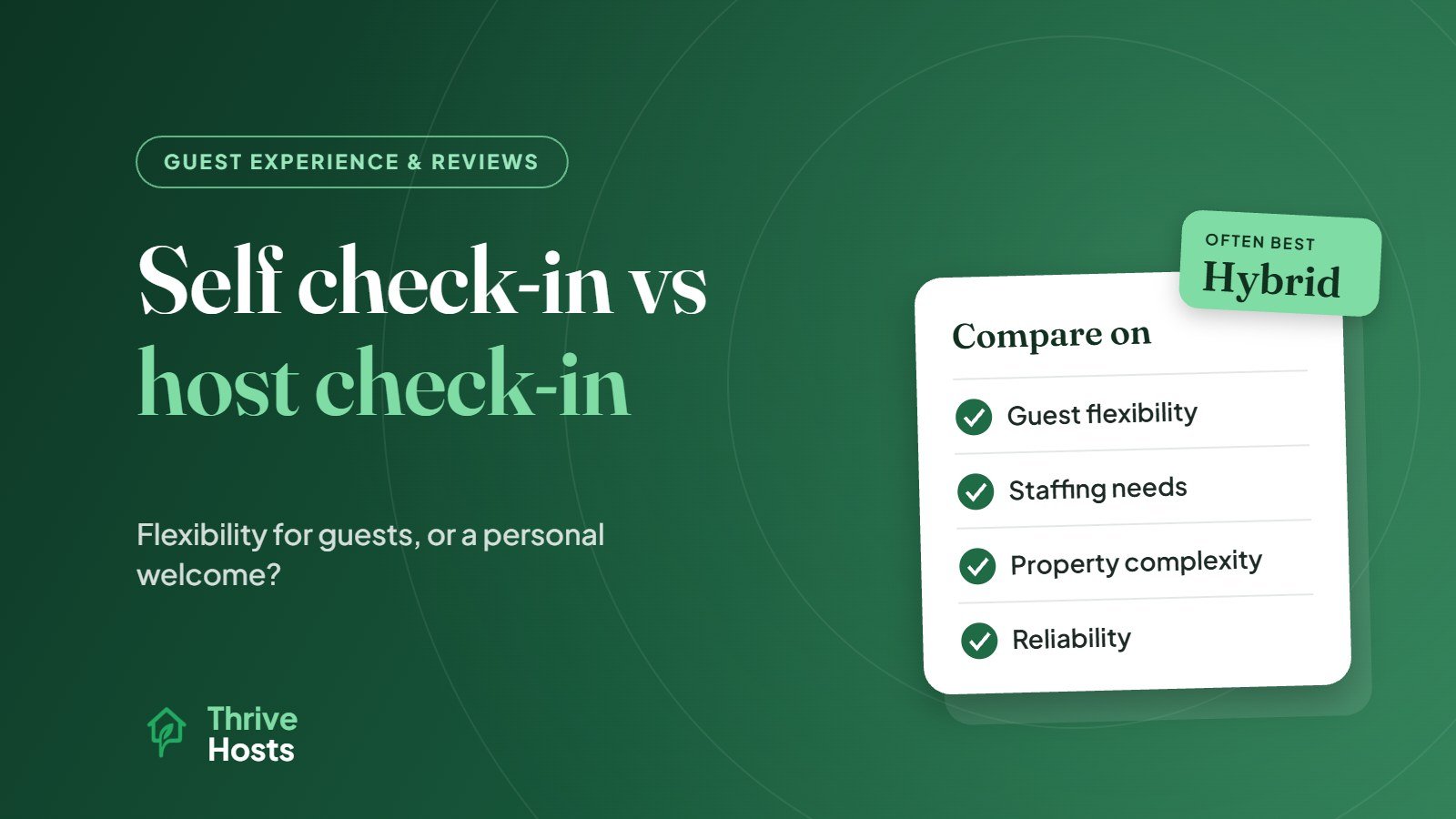
Self check-in lets guests let themselves in with a code, lockbox or smart lock, at any time within the check-in window. Host check-in means someone meets the guest in person to hand over keys and show them around. For most short-term rentals, and almost all remotely managed ones, self check-in is the better default: it is more flexible for guests, easier to staff, and something many guests actively look for. Host check-in still has a place for certain properties and guests, and some hosts combine the two.
The right choice depends on your property, your guests and who is realistically available at arrival time.
How Each Option Works
Airbnb describes the common check-in methods as an in-person meeting with the host, co-host, a concierge or a neighbor; a lockbox with a key inside; or a keypad or smart lock. Self check-in covers the last two, and any setup where the guest can get in without meeting someone.
With host check-in, the guest agrees an arrival time, someone meets them, hands over the keys and usually gives a short tour. With self check-in, the guest receives instructions and an access code before arrival and lets themselves in.
The Case for Self Check-In
Flexibility for guests. Flights are delayed, traffic happens, and many guests prefer not to commit to an exact arrival time. Self check-in means they can arrive whenever suits them within your check-in window, without waiting for anyone.
Guest demand. Self check-in appears among the amenities guests search for most often on Airbnb, according to its own Resource Center article on the amenities guests want. Listings that offer it can show up in more filtered searches.
Easier for remote owners. If you live far from the property, host check-in requires someone local to be available for every arrival, including evenings and weekends. Self check-in removes that dependency.
Consistency. Every guest gets the same clear process. There is no variation depending on who meets them or how rushed the handover is.
The Case for Host Check-In
Complex properties. Some homes are genuinely difficult to explain in writing: unusual heating systems, a pool or hot tub with specific rules, a farm with gates and animals, or a building where access involves several doors and a concierge.
Higher-value or longer stays. Guests on luxury or extended stays may value a personal welcome, a proper walkthrough and a face to associate with the property.
Reassurance for some owners. Meeting guests allows you to confirm the group size and set expectations in person. That said, an in-person meeting is not a substitute for clear house rules and good screening.
No suitable lock option. In some buildings, rules or door types make smart locks and lockboxes impractical.
The Downsides of Each
Self check-in depends on good instructions and reliable technology. If the code does not work, the battery is flat or the guest cannot find the entrance, there is nobody there to help, which is why clear instructions and a backup plan are essential. Our guide on how better check-in instructions reduce guest problems covers this in detail.
Host check-in depends on people. Someone must be available at every arrival time, guests have to coordinate with them, and late or early arrivals create scheduling problems. For a remote owner, it usually means paying or relying on a local contact for every booking. It also tends to narrow the arrival window, which can make your listing less attractive to guests travelling at awkward hours.
A Hybrid Often Works Best
Many hosts combine the two. The default is self check-in through a smart lock or keypad, so guests can arrive whenever they need to. A short welcome message or video walkthrough covers the things a host would normally show in person. And for properties with complicated features, a local contact is available by phone, or can meet guests who request it.
This gives guests the flexibility they prefer while keeping a person close enough to help.
Making Self Check-In Work Reliably
- Choose the right access method. A Wi-Fi connected smart lock that issues a unique code for each stay is more secure and easier to manage remotely than a lockbox with a fixed code. See how smart locks help remote Airbnb hosts.
- Write step-by-step instructions with photos of the entrance, parking and lock.
- Send instructions at the right time and again on the morning of arrival.
- Confirm the property is ready before the check-in window opens, with photos from your cleaner.
- Have a backup entry method and someone who can respond quickly if the main method fails.
Which Should You Choose?
Choose self check-in if you manage remotely, your property is straightforward to access, and guests arrive at varied times. Choose host check-in, or a hybrid, if your property genuinely needs explanation in person, or if your guests expect a personal welcome. Whichever you choose, describe it accurately in your listing so guests know exactly what to expect before they book.
Getting Arrival Covered
Thrive Hosts supports remote owners with arrival management as part of Airbnb co-hosting: access codes, check-in instructions, readiness checks with your approved local cleaner, and real-time guest support during arrival.
You keep your property and accounts. We make sure every guest has a smooth way in, whichever method you use.
See how co-hosting covers check-in
Find out how we would handle arrivals for your property, from access codes and instructions to real-time support when something goes wrong.
See How Airbnb Co-Hosting Works
Bruce J is the CEO of Thrive Hosts and leads the short-term rental team. He works on the operations and performance side of STR: guest communication, pricing and calendar discipline, turnovers, issue tracking and owner reporting across Airbnb, Vrbo and Booking.com. On the blog he writes practical, no-fluff guides for owners and operators who want their rentals to run more consistently.