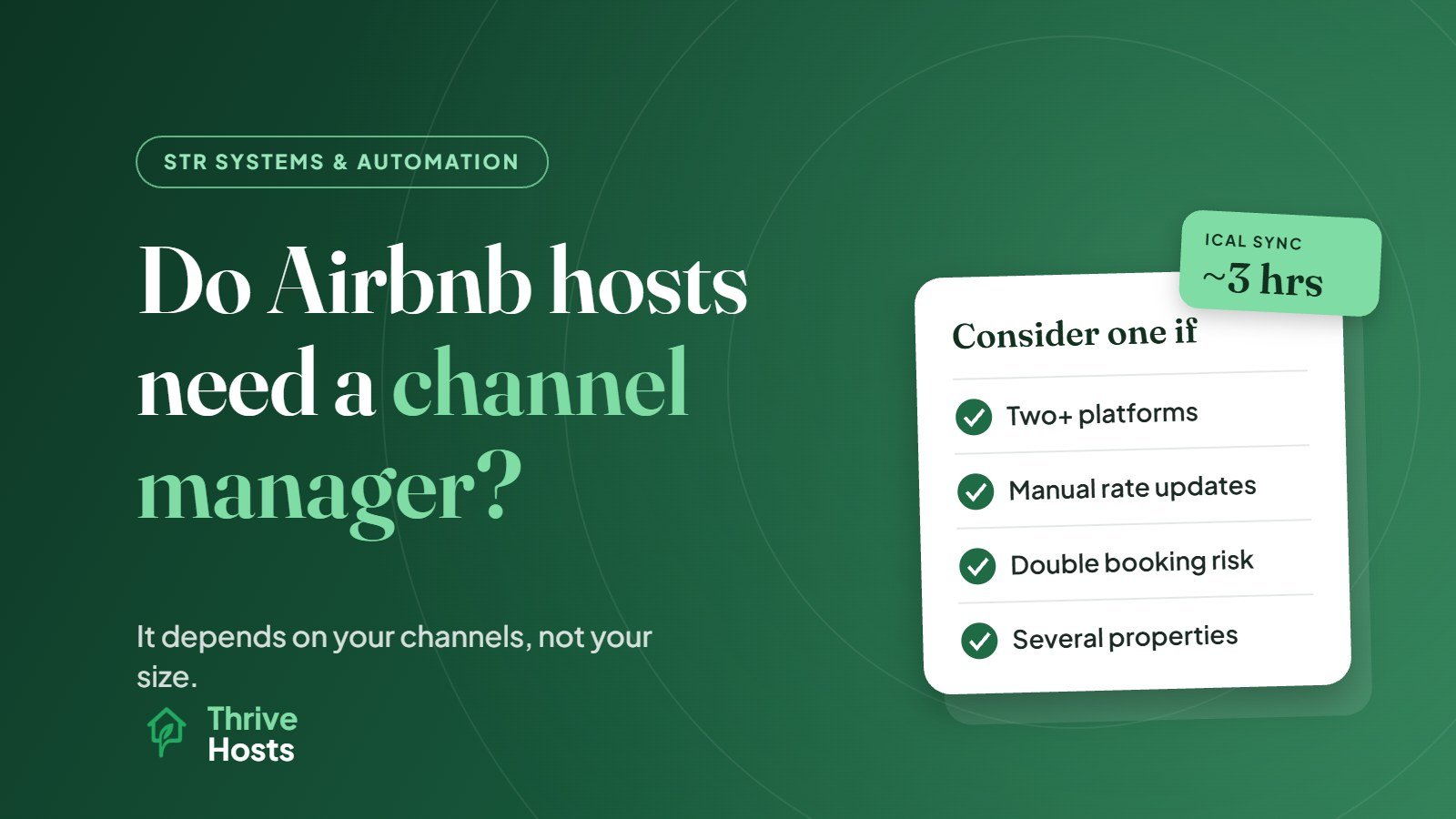
Not every Airbnb host needs a channel manager. If you list one property only on Airbnb, you almost certainly do not. Once you list the same property on more than one platform, such as Airbnb plus Vrbo, Booking.com or your own website, a channel manager becomes worth considering, and with several properties across several channels it is close to essential. The deciding factor is not your size. It is how much risk and manual work comes from keeping calendars and prices aligned by hand.
For a quick check against your own setup, try the free channel manager readiness checklist. It scores your listings, channels and syncing method and shows which answers point towards automating.
When You Do Not Need One
A channel manager solves a distribution problem: keeping availability, rates and rules consistent across booking sites. If Airbnb is your only channel, there is nothing to keep in sync. Airbnb’s own calendar, pricing settings and messaging tools cover the basics, and adding a channel manager would mostly add cost.
You may still want software at this stage, for automated guest messages, cleaning schedules or owner reporting. That is the job of a property management system rather than a channel manager. If the two terms are blurring together, our explainer on PMS vs channel manager sets out the difference.
When iCal Might Be Enough
Many hosts who add a second platform start with iCal, the free calendar links that Airbnb, Vrbo and Booking.com provide. You export each platform’s calendar link and import it into the others, so a booking on one blocks the dates on the rest.
iCal can work for a single property with moderate demand and mostly longer lead times. But it has real limits. Airbnb’s help center says imported calendars update automatically every 3 hours, unless you refresh them manually, and other platforms run on their own schedules. iCal only shares blocked dates. It does not sync prices, minimum stays, listing content or messages, so each of those has to be updated on every platform separately.
The gap between updates is where double bookings happen. A guest books on Vrbo, and before Airbnb’s next calendar refresh someone books the same dates on Airbnb. In a busy period or for last-minute dates, that window matters.
What a Double Booking Actually Costs
A double booking is not just awkward. One of the two guests has to be cancelled, and that has consequences. Under Airbnb’s host cancellation policy, hosts who cancel a confirmed booking without a valid reason pay a fee based on how close to check-in the cancellation happens: 10% of the reservation amount more than 30 days out, 25% between 48 hours and 30 days, and 50% within 48 hours or after check-in, with a minimum of $50. Airbnb may also block the calendar for those dates, and repeated cancellations can affect Superhost status and the listing itself. Airbnb specifically lists double-booking as an example of conditions that can make a host responsible.
Vrbo weighs cancellations heavily as well. Its Premier Host standards from 2026 require a 0% partner-initiated cancellation rate. Then there is the guest who was cancelled, who now has to find somewhere else to stay, and who may be the start of a difficult review.
Measured against that, the cost of a channel manager subscription often looks small.
Signs You Need a Channel Manager
- You list on two or more platforms and update prices or minimum stays on each one by hand.
- You have had a double booking, or a near miss you caught by luck.
- Your calendars disagree because dates were blocked on one site but not another.
- You avoid listing on another platform because keeping it aligned feels like too much work.
- You manage several properties and spend real time each week on calendar maintenance.
- You use a dynamic pricing tool and want its rates pushed to every channel automatically.
If two or three of those apply, a channel manager, or a PMS with built-in channel management, is likely worth it.
What to Look For
The most important question is how each platform is connected. API connections can sync availability, rates and rules much faster than iCal, and often content and messages too. Check which channels a tool connects to by API and which it still connects to by iCal, because some smaller sites only support iCal.
Beyond that, look at whether it supports your pricing tool, how it handles minimum stays and fees on each channel, how setup works, and how pricing changes as you add properties. And plan for setup time: connecting channels, mapping listings and checking that rates and rules come through correctly takes care.
The Operational Side Still Matters
A channel manager reduces the risk of calendar errors, but it does not replace oversight. Someone still needs to check that new bookings appear everywhere, that blocked dates are applied correctly, that fees and minimum stays look right on each platform, and that the connection has not quietly failed. Most double bookings with channel managers come from setup mistakes or manual edits made directly on one platform. Our guide to optimizing a Vrbo listing covers why this kind of accuracy is so important there.
Getting Multi-Channel Operations Support
Thrive Hosts helps owners set up and run multi-channel operations as part of remote short-term rental operations support, including channel connections, calendar checks, pricing across platforms, guest messaging and cleaner coordination with your approved local team.
You keep ownership of your accounts and software. We make sure your channels stay aligned and someone is watching for problems before guests notice them.
Explore STR systems support
We will review how your calendars and channels are connected today and show you where the risk of double bookings or manual errors sits.
Explore STR Operations Support
Bruce J is the CEO of Thrive Hosts and leads the short-term rental team. He works on the operations and performance side of STR: guest communication, pricing and calendar discipline, turnovers, issue tracking and owner reporting across Airbnb, Vrbo and Booking.com. On the blog he writes practical, no-fluff guides for owners and operators who want their rentals to run more consistently.