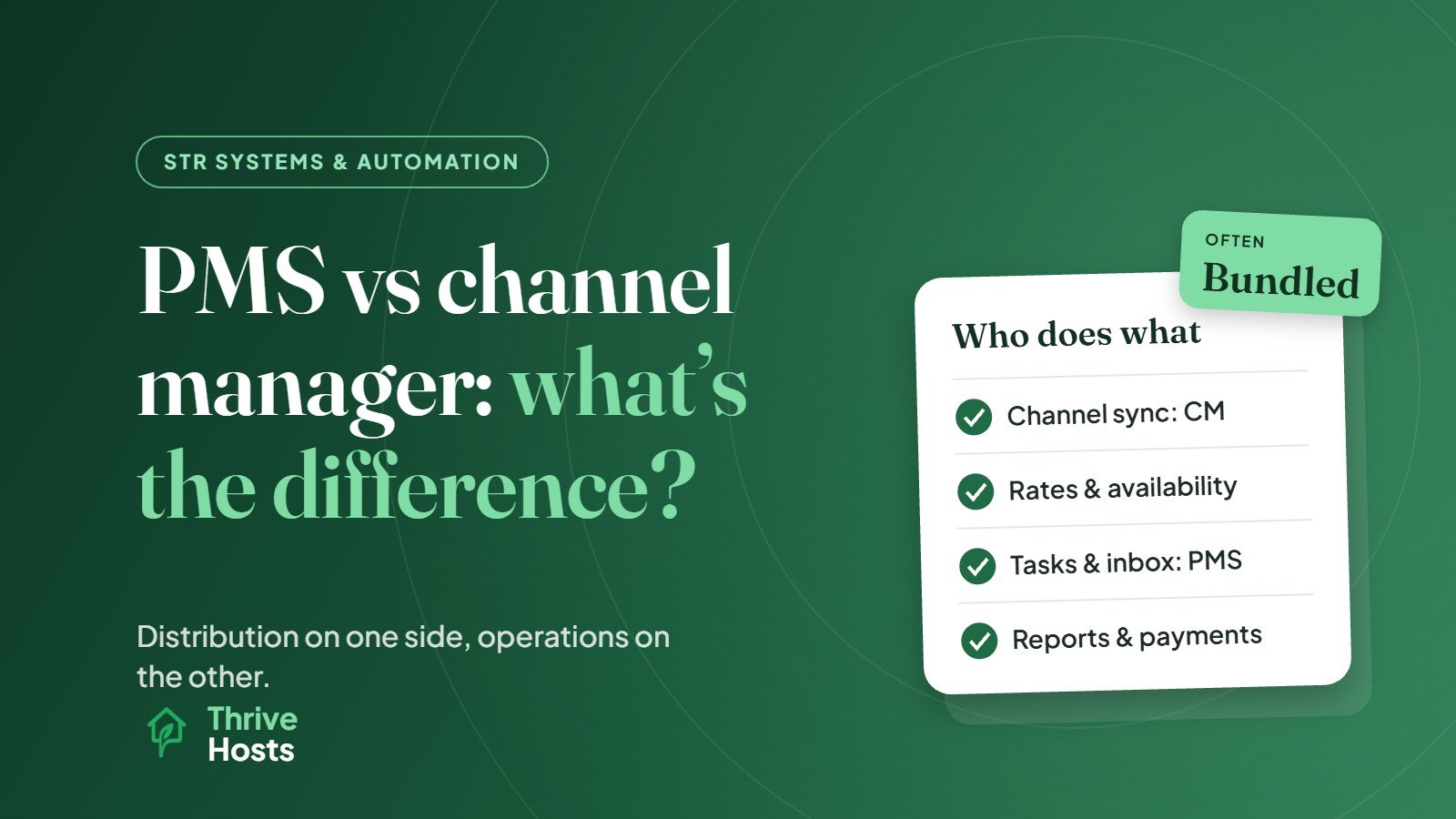
A channel manager keeps your listings, availability and rates in sync across booking platforms such as Airbnb, Vrbo and Booking.com. A property management system, or PMS, runs the operation behind those bookings: the reservation records, guest messaging, cleaning tasks, payments, owner statements and reporting. One handles distribution. The other handles operations.
In hotels these are often separate products. In short-term rentals they are frequently bundled, which is why the terms get confused. Many vacation rental platforms include a channel manager inside the PMS, while some tools focus on just one job.
What a Channel Manager Does
A channel manager connects your property to several booking channels and acts as the central source of truth for availability and pricing. When a booking comes in on Airbnb, the channel manager blocks those dates on Vrbo, Booking.com and your direct booking site. When you change a rate, it pushes the new price to every connected channel.
Most channel managers do this through direct API connections with the platforms. That is the key difference from basic calendar syncing. With iCal, the free calendar links most platforms offer, only blocked dates are shared, and updates happen on a schedule. Airbnb’s help center says imported calendars update automatically every 3 hours, unless you refresh them manually. iCal does not sync prices, minimum stays, listing content or messages. An API connection can sync much more, much faster, depending on the platform and the tool.
A channel manager typically handles:
- Availability and booking sync across channels.
- Rates, minimum stays and other pricing rules.
- Listing content such as descriptions, photos and amenities, depending on the channel.
- Bringing reservations from every channel into one calendar.
What it usually does not do is run the day-to-day operation: scheduling cleaners, sending guest messages, tracking maintenance or producing owner reports. Some do a little of this, but it is not their main job.
What a Property Management System Does
A PMS is the operating system for the business. It holds every reservation with guest details, dates, amounts and payment status, and it builds workflows around them. In short-term rentals that usually includes:
- Unified inbox: guest messages from different channels in one place, with saved replies and scheduled messages.
- Task management: cleaning and maintenance tasks created automatically from bookings and assigned to your team.
- Payments and accounting: payouts, fees, damage deposits and owner statements.
- Reporting: occupancy, average daily rate, revenue and channel performance.
- Integrations: dynamic pricing tools, smart locks, noise monitors, accounting software.
If a channel manager answers “is this date available and at what price, everywhere?”, a PMS answers “what needs to happen because of this booking, and who is doing it?”
Why the Lines Blur
Most short-term rental software sold today combines both functions. You connect your Airbnb, Vrbo and Booking.com accounts, the software syncs availability and rates through API connections, and the same system runs messaging, tasks and reporting. In everyday conversation, hosts call these platforms either a PMS or a channel manager.
There are also standalone tools on each side: lighter channel managers aimed at hosts who mainly need multi-platform sync, and operational tools that focus on cleaning, messaging or reporting while relying on another product for distribution. When comparing options, look at what the software actually does rather than what it is called.
Which One Do You Need?
The answer depends on your channels and how much operational work you are carrying.
One property, one platform. If you only list on Airbnb, you may not need either. Airbnb’s own tools cover messaging, calendar and pricing basics. Many hosts at this stage add software later for automated messaging or cleaning schedules rather than for distribution.
Several channels. Once you list on two or more platforms, reliable sync becomes important. iCal can work for a single property with modest demand, but it leaves gaps between updates, and a double booking can be costly, especially on platforms like Vrbo where cancellations affect your standing. A channel manager or a PMS with built-in channel management reduces that risk.
Several properties or a team. When cleaners, maintenance and owner reporting need coordinating across properties, a PMS starts paying for itself in time saved and mistakes avoided. Most hosts at this stage choose a combined platform.
Questions to Ask Before Choosing Software
- Which channels are connected by API, and which only by iCal?
- What exactly syncs on each channel: availability, rates, minimum stays, content, messages, reviews?
- Can it create cleaning tasks automatically and share them with your cleaners?
- Does it integrate with your pricing tool, smart locks and accounting software?
- How does pricing work as you add properties, and is there a contract term?
- Who will set it up and keep the configuration correct?
That last question matters more than most hosts expect. Software reduces manual work only when it is set up properly and someone checks that it is doing what it should.
If you are working on listings across several platforms, our guide to optimizing a Vrbo listing covers why calendar accuracy matters so much on Vrbo, and dynamic pricing for short-term rentals explains how pricing tools usually connect to these systems.
Running a small hotel, motel or inn rather than rentals? Our guide to whether a small hotel needs a PMS and a channel manager covers the hotel side of this decision.
Getting Your Systems Set Up Properly
Thrive Hosts helps owners choose, configure and run STR systems as part of remote short-term rental operations support. That includes channel connections across Airbnb, Vrbo and Booking.com, messaging templates, cleaning workflows with your approved local team, pricing tool integrations and owner reporting.
You keep ownership of your accounts and software. We make sure the systems behind them work together and stay maintained.
Explore STR systems support
We will review your current tools and channel setup and show you where sync gaps or manual work are creating risk.
Explore STR Operations Support
Bruce J is the CEO of Thrive Hosts and leads the short-term rental team. He works on the operations and performance side of STR: guest communication, pricing and calendar discipline, turnovers, issue tracking and owner reporting across Airbnb, Vrbo and Booking.com. On the blog he writes practical, no-fluff guides for owners and operators who want their rentals to run more consistently.