Dynamic pricing means your nightly rate changes automatically based on demand, instead of staying fixed until you remember to update it. Rates rise when demand is strong, such as peak season, weekends, holidays and local events, and fall when demand is weaker or a date is getting close and still unbooked. The goal is not simply higher prices. It is the right price for each individual night.
For short-term rentals this matters because every night is perishable. An empty Tuesday cannot be sold next month. A fixed price is almost always too low for some dates and too high for others.
How Dynamic Pricing Works
Every dynamic pricing system follows the same basic idea. It starts with a reference point, usually a base price that represents a typical night for your property. It then adjusts that price for each date using signals about demand.
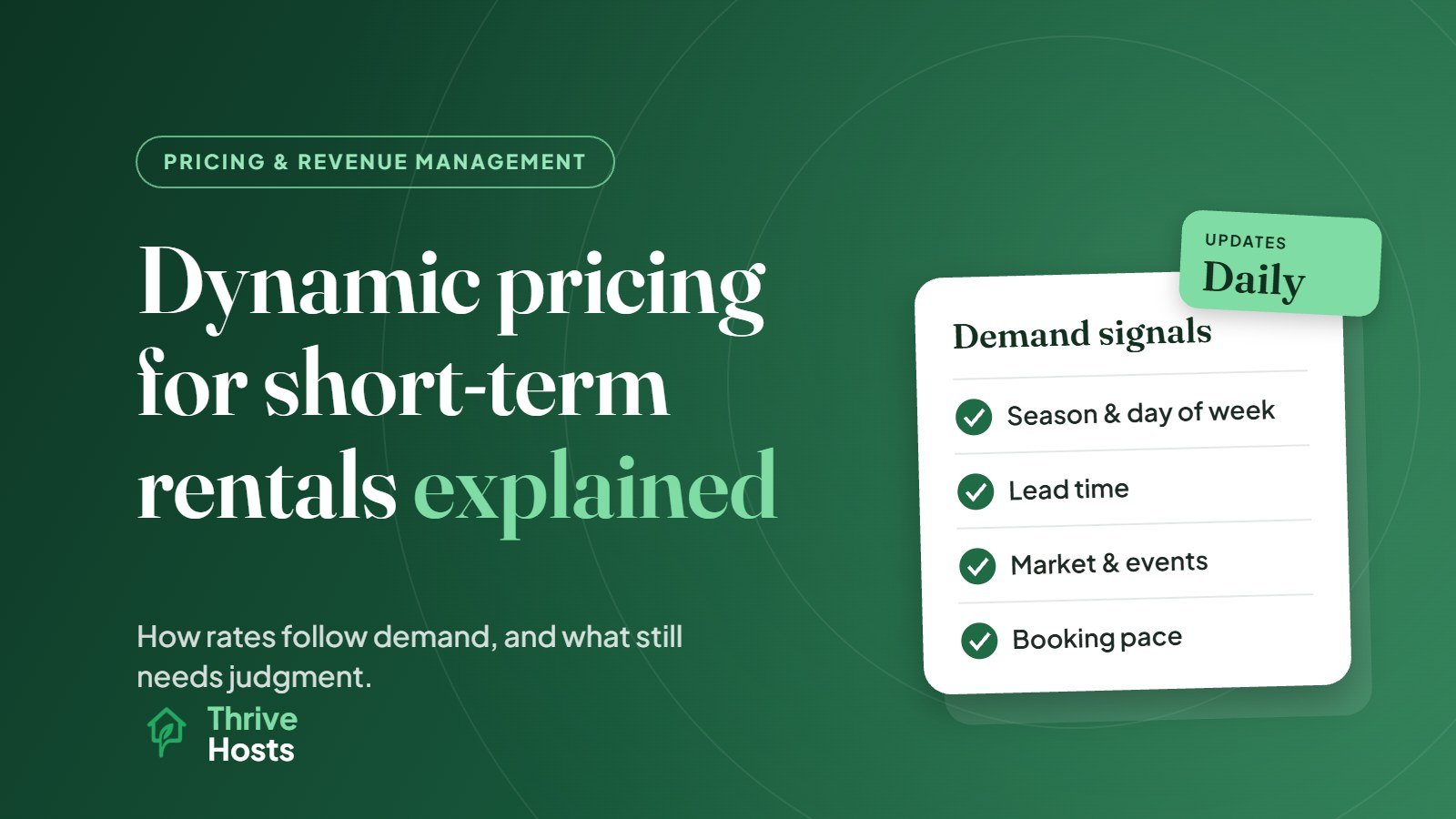
The most common signals include:
- Seasonality: the time of year and how your market normally performs then.
- Day of week: weekends and weekdays behave differently in most markets, though not always in the same direction.
- Lead time: how far away the date is. Prices often start higher far out and adjust as the date approaches.
- Market demand: how quickly comparable listings are booking for that date and what they are charging.
- Events and holidays: concerts, conferences, sports fixtures and school holidays.
- Your own booking pace: whether you are filling faster or slower than expected.
The system combines these into a recommended rate for each night, usually updated daily. Some tools also adjust minimum stays, handle orphan nights between bookings, and apply last-minute or far-out rules.
The Three Main Ways Hosts Use It
Built-in platform pricing
Airbnb offers Smart Pricing, which according to Airbnb’s help center adjusts nightly prices based on demand within a minimum and maximum you set. You can override individual nights, and weekly, monthly and trip-length discounts still apply on top. It is free and simple to switch on, but it only covers Airbnb and gives you limited control over how decisions are made.
Third-party dynamic pricing tools
Specialist tools such as PriceLabs, Beyond and Wheelhouse connect to your listings, often through a property management system or channel manager, and push prices to several platforms at once. They usually offer more settings, more market data and more control over rules, in exchange for a subscription fee and a learning curve.
Pricing inside a PMS
Some property management systems include their own pricing engine or integrate closely with one. This keeps pricing alongside your calendar, messaging and operations, which can be convenient for hosts managing several properties and channels.
What Dynamic Pricing Does Not Do for You
A pricing tool is only as good as the settings behind it. It does not know that your property is the only one in the area with a hot tub, that your reviews mention a noisy road, or that you have just renovated. It cannot decide your strategy for you.
You still need to set a sensible base price, a minimum price you are genuinely comfortable with, and a maximum that does not leave money on the table during major events. You need to decide minimum-stay rules, how aggressively to discount last-minute dates, and how to treat gap nights. Poorly configured dynamic pricing can drop rates too far, too fast, and fill your calendar with low-value bookings that create more turnovers than they are worth.
Settings That Matter Most
If you are starting with dynamic pricing, focus on a handful of settings rather than every option:
- Base price: your anchor. If it is wrong, every recommendation built on it will be off.
- Minimum price: the floor below which a booking is not worth the cleaning, wear and effort.
- Last-minute adjustments: how much the price drops as an unbooked date approaches, and from how many days out.
- Far-out pricing: whether to hold rates higher for dates many months away.
- Minimum stay and gap rules: whether shorter stays are allowed to fill gaps between existing bookings.
Review these regularly against what is actually happening, not just once at setup.
Is Dynamic Pricing Right for You?
For most short-term rental hosts, some form of dynamic pricing is better than fixed rates, because demand genuinely changes from night to night. The real question is which approach and how much oversight it needs. If you are weighing Airbnb’s built-in option against a third-party tool or managing rates yourself, our comparison of Airbnb dynamic pricing vs manual pricing covers the trade-offs.
Whatever you choose, someone still needs to watch the results: booking pace, occupancy, average nightly rate and gaps in the calendar. Automation handles the daily arithmetic. Judgment is still needed on top.
Getting Pricing Oversight
Thrive Hosts provides pricing and calendar management as part of remote short-term rental operations support. We work with your chosen pricing tool or set one up, configure the rules around your property and market, and review results regularly so automation does not run unchecked.
You keep control of your listings, accounts and pricing decisions. We make sure your rates and calendar are being actively managed.
Explore pricing and revenue support
We will look at how your current pricing is set up, where it may be leaving gaps or underpricing busy dates, and what a better setup would look like.
Explore Pricing & Revenue Support
Bruce J is the CEO of Thrive Hosts and leads the short-term rental team. He works on the operations and performance side of STR: guest communication, pricing and calendar discipline, turnovers, issue tracking and owner reporting across Airbnb, Vrbo and Booking.com. On the blog he writes practical, no-fluff guides for owners and operators who want their rentals to run more consistently.