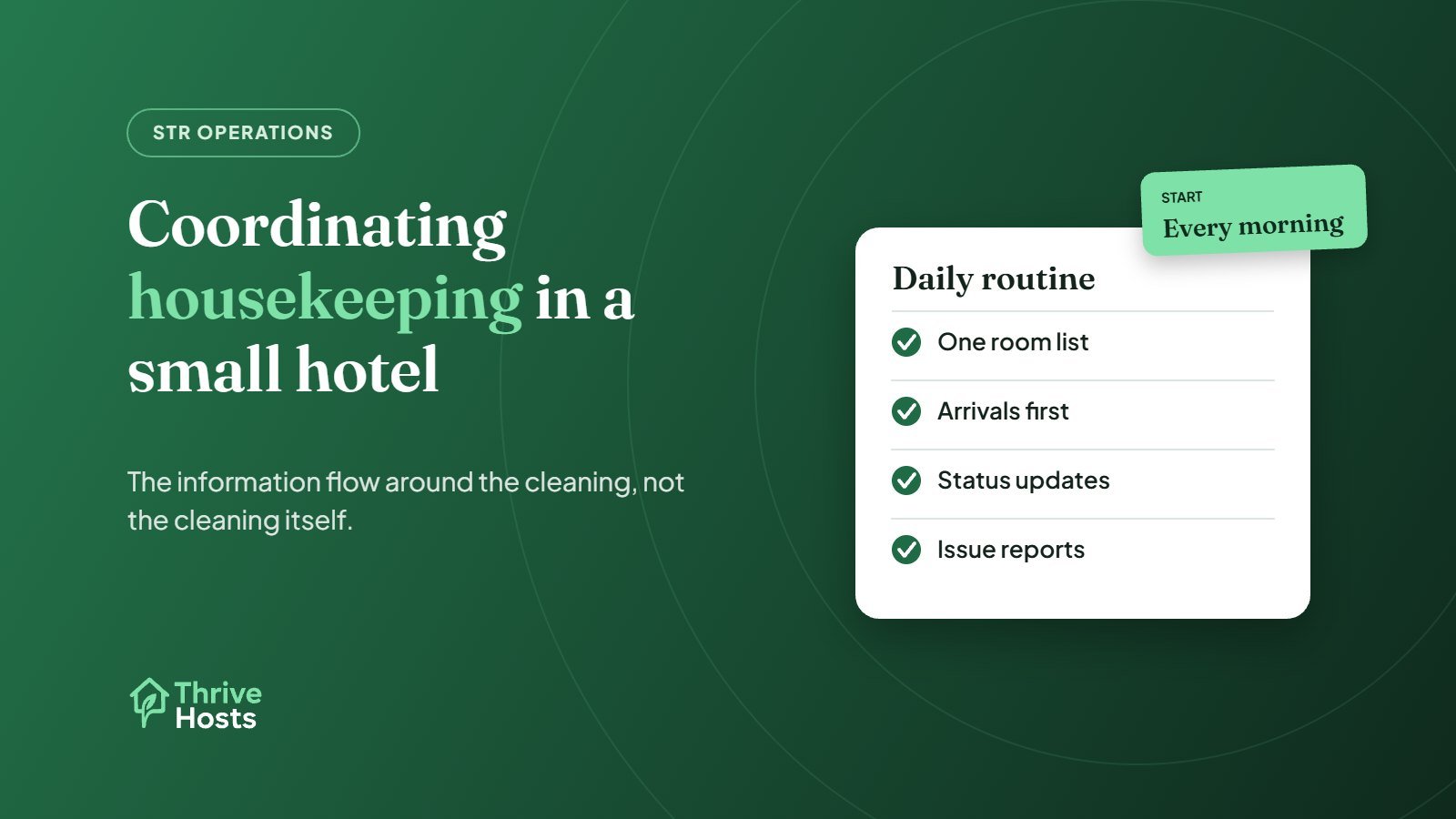
Housekeeping coordination is the flow of information around the cleaning, not the cleaning itself. In a small hotel or motel, the housekeepers usually know how to turn a room. Problems start when they do not know which rooms to prioritise, when a guest is arriving early, which room a guest complained about, or that a family moved rooms at midnight. Most housekeeping complaints are really communication failures.
This guide sets out a coordination routine that works with a small team and a front desk that is not staffed every hour.
Start every day with one room list
Before housekeeping starts, the team should have one list for the day, taken from the PMS or reservation system, showing every room’s status: departures, stayovers, arrivals, vacant rooms and out-of-order rooms. Add arrival times where guests have shared them, and mark any special requests such as an extra bed, a cot or an accessible room.
The list should be produced by whoever manages reservations, not reconstructed by housekeepers from memory or a whiteboard. If your PMS has a housekeeping report, use it. If not, a shared sheet updated each morning is better than nothing. The point is that housekeeping and the desk work from the same information.
Prioritise rooms by arrival, not by corridor
It is natural to clean rooms in the order you walk past them. It is better to clean departure rooms with confirmed early arrivals first, then other arrivals, then stayovers. If a guest has messaged through Booking.com that they land at 10am and would like early check-in, that request needs to reach housekeeping before the shift starts, not when the guest is standing at the desk. Our OTA inbox workflow explains how to route these requests.
Agree on room status updates
The desk needs to know when a room is ready. Decide how housekeepers report it: updating status in the PMS from a phone, a message in a team group, or ticking the shared sheet. Whatever the method, it should be quick enough that housekeepers actually do it. A room that is clean but still marked dirty is as costly as a room that is dirty but marked clean, because one keeps a guest waiting and the other sends a guest into an unready room.
Handle late checkouts and room moves in writing
Late checkouts, extended stays and room moves cause most mid-day confusion. When one is approved, the change should be written into the room list and sent to housekeeping straight away, with the room number and new time. Verbal handovers get lost between shifts, especially when the night or evening desk is unstaffed.
Give housekeepers a simple way to report problems
Housekeepers see problems first: a dripping tap, a stained mattress, a broken lamp, a missing remote. Give them one way to report them, with a photo and room number, and make sure someone reviews those reports the same day. The person reviewing decides whether the room can still be sold, whether maintenance is needed, and whether the next guest should be told. This is how small issues stop turning into repeat guest complaints.
Close the loop on guest-reported housekeeping issues
When a guest reports a cleanliness issue during the stay, it usually arrives through the desk, the phone or an OTA message. The guest should get a quick reply confirming someone is on it, housekeeping should get the room number and the specific problem, and the guest should be told once it is fixed. If the desk is closed, the person covering guest messages should know who to contact. Our article on handling guest issues without a 24-hour front desk covers escalation in more detail.
Track supplies before they run out
Running out of towels, toiletries or coffee pods is a coordination problem, not a cleaning one. Ask housekeepers to flag low stock as part of their end-of-shift report, and have one person responsible for reordering. Weekly stock counts for the main items prevent the Saturday-morning scramble.
Review housekeeping exceptions weekly
Once a week, look at the exceptions: rooms not ready on time, guest complaints about cleanliness, repeat maintenance issues and stock shortages. Look for patterns. If the same room keeps being late, it may need more time on the schedule. If complaints cluster on one day, staffing may be thin that day. These are management decisions, and they are easier with a short summary in front of you.
What can be coordinated remotely
Much of the information flow above does not need anyone on site. A remote team can prepare the daily room list from reservations, pass early-arrival and late-checkout requests to housekeeping, follow up on room readiness, log issues reported by guests and housekeepers, chase maintenance with your vendors and send the owner a weekly summary. The cleaning, inspections and repairs stay with your on-site staff and approved vendors.
If that split would help your property, see how our small hotel operations support handles housekeeping coordination alongside the OTA inbox and reporting.
Housekeeping running on phone calls and memory?
Thrive Hosts coordinates remotely with your on-site housekeeping team: daily room information, early arrivals, guest-reported issues, supply flags and follow-up, so the desk and housekeeping work from the same picture.
Explore hotel & motel operations
Bruce J is the CEO of Thrive Hosts and leads the short-term rental team. He works on the operations and performance side of STR: guest communication, pricing and calendar discipline, turnovers, issue tracking and owner reporting across Airbnb, Vrbo and Booking.com. On the blog he writes practical, no-fluff guides for owners and operators who want their rentals to run more consistently.