If your Airbnb listing is getting fewer bookings than expected, the problem is not always your nightly rate. It could be visibility, restrictive calendar rules, weak search-result presentation, poor conversion after the click, or simply an offer that is no longer competitive for the dates guests are searching.
The mistake is changing everything at once. A host drops the price, rewrites the title, changes the first photo, adds a discount and loosens the minimum stay in the same afternoon. A booking comes in three days later, but there is no way to know which change actually helped.
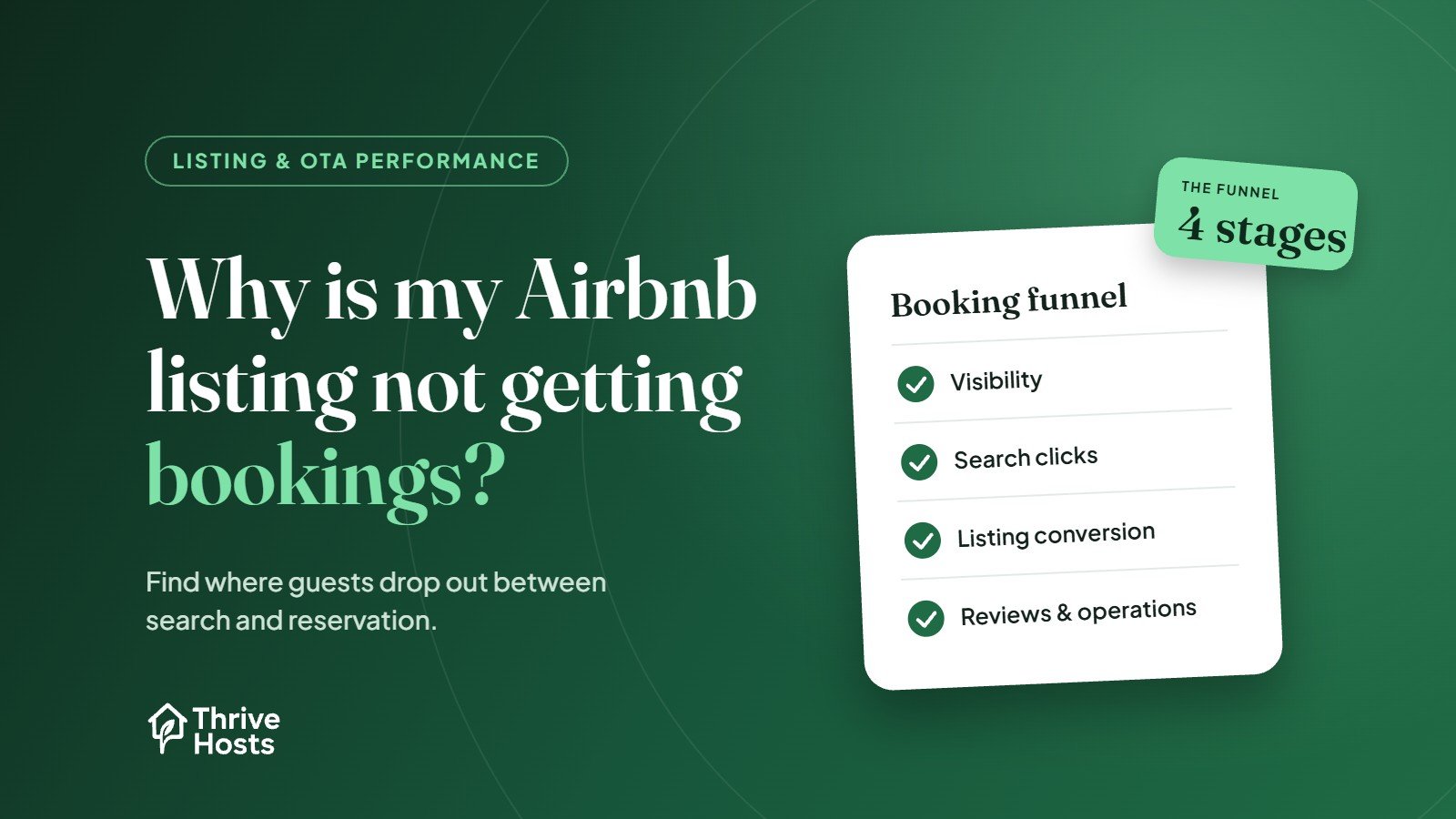
A better approach is to work through the booking funnel in order: Are guests seeing the listing? Are they clicking it? And once they open it, are they booking?
That distinction matters because Airbnb’s own search documentation says results are influenced by a range of factors, including price, calendar availability, images, reviews, guest engagement, ease of booking and host requirements such as minimum stays and booking cut-off times.
Here is how to diagnose where your listing may be losing bookings.
Start With Visibility, Not the Listing Description
If very few guests are seeing your property in the first place, rewriting three paragraphs of your description is unlikely to solve the main problem.
Hosts using Airbnb’s professional hosting tools can access conversion data that separates the journey into search impressions, search-to-listing conversion and listing-to-booking conversion. Even if you do not have every metric available, this is still a useful way to think about performance.
Low visibility can come from several places. Your pricing may put you outside the range guests are considering for particular dates. Your calendar may not match common trip lengths. Minimum-stay rules may remove you from shorter searches. Advance notice, preparation time or booking-window settings can also reduce the number of searches for which your property is eligible.
So before deciding that Airbnb has simply “stopped showing” your property, check whether your own settings are limiting where it can appear.
Your Calendar Can Look Open and Still Be Hard to Book
Calendar configuration is one of the easiest performance problems to overlook.
Suppose you have a three-night gap between two reservations but your minimum stay is four nights. To you, those dates look available. To a guest searching for those exact three nights, they may effectively be unusable.
The same issue can appear when one blanket minimum stay is applied across the entire calendar. A five-night minimum might work during peak summer demand but make much less sense during a slower midweek period. Check-in restrictions can create awkward orphan nights, while too much advance notice can remove your property from last-minute searches.
Airbnb specifically states that booking requirements such as minimum stays, advance notice and preparation time can affect whether a listing appears for a guest’s search. Airbnb also advises hosts that adjusting trip-length settings can open more availability and help a listing appear in more searches.
That does not mean every property should accept one-night bookings. The right rule depends on your market, turnover costs, local restrictions and operating model. The point is that calendar rules should respond to demand instead of being set once and forgotten.
If you are already dealing with guest communication, cleaners, calendars and multiple booking channels yourself, this is one of the areas where ongoing Airbnb co-hosting can be more useful than occasionally logging in and changing settings after bookings slow down.
Your Price May Be Reasonable but Still Not Competitive
Hosts naturally think about price from the property’s perspective: the location is good, the furniture is expensive, the kitchen was renovated, and the property “should be worth” a certain nightly rate.
Guests do not shop that way. They search their dates and compare the available options in front of them.
A $250 rate may be completely reasonable in one week and poorly positioned in another. If similar properties are available for $195 on the same dates, the guest needs to see a clear reason to pay the difference.
This is why good STR pricing is less about finding the perfect base rate and more about managing individual dates. Weekends may behave differently from weekdays. Event dates may support higher pricing. A gap between bookings may need different treatment from an open weekend three months away. Last-minute dates may require a different strategy than dates with plenty of booking lead time remaining.
Also look at the guest’s total value proposition rather than only the nightly number. A competitive base rate can become less attractive when the total stay cost rises, while a more expensive property can still win if the photos, amenities, reviews and overall offer clearly justify it.
The answer is not automatically to lower your rates. It is to know which dates have a pricing problem and which dates do not.
If Guests See the Listing but Do Not Click, Look at the Search Result
Healthy impressions with weak listing views suggest a different problem. Guests are seeing you, but something else is winning the click.
This is where your lead photo becomes critical. A good photograph is not automatically a good search-result image. The first image needs to communicate something compelling about the stay quickly, especially when a guest is comparing several properties on a phone.
Look at your listing alongside comparable stays rather than reviewing it in isolation. Does your first image immediately show the property’s strongest selling point? Does the overall presentation feel current? Are guests seeing a bright living space, view, pool, bedroom or outdoor area that gives them a reason to open the listing?
Airbnb lists the number and quality of images among the listing characteristics considered in how search results are ranked and displayed. But beyond the algorithm, photos have an even simpler job: they need to make a real guest stop scrolling.
Your title and visible listing details also need to support that first impression. Do not try to cram every possible search phrase into the title. Make the property easy to understand and give the right guest a clear reason to investigate further.
If Guests Click but Do Not Book, You Have a Conversion Problem
This is where many hosts should stop thinking about “Airbnb SEO” altogether.
If guests are finding the property and opening the page, visibility has already done part of its job. Now the question becomes why those visitors are not comfortable making the reservation.
Go through the listing as if you knew nothing about the property. Is the sleeping arrangement obvious? Is parking explained? Does the photo order answer the questions guests are likely to have? Are important amenities correctly selected in Airbnb rather than only mentioned deep in the description? Is the check-in process clear? Are the house rules proportionate to comparable stays?
Then look at value. If your property costs more than similar options, can the guest quickly see why? If it costs roughly the same, does another listing appear easier to book, better presented or more trusted?
A strong Airbnb listing reduces uncertainty. Guests should not have to investigate ten photos and six paragraphs to figure out whether there is parking, whether the second bedroom has an actual bed, or whether the pool is private.
Listing optimization is not about adding more words. Often it is about removing friction.
Recent Reviews Can Reveal an Operations Problem
Reviews are useful for more than displaying a star rating. They can tell you where the guest experience is breaking down.
If recent reviews repeatedly mention confusing check-in, slow responses, cleanliness issues, inaccurate information or maintenance problems, changing your cover photo is not enough. The listing may have an operations problem behind the marketing problem.
Airbnb includes reviews, ratings, customer-service history and other quality signals among the factors associated with search results. Its Guest Favorites system also considers areas such as check-in, cleanliness, accuracy, host communication, location, value and reliability.
More importantly, prospective guests read those reviews.
If several people mention the same issue, treat that as operational data. Update the check-in workflow. Coordinate with the approved local cleaner. Fix the listing details that are causing expectation gaps. Improve how issues are tracked and followed through.
This is where listing performance and daily STR operations start to overlap. A property cannot be marketed around a guest experience that the operation consistently fails to deliver. If you are not on site, our guide on how to manage a short-term rental remotely covers how to build the systems that keep that experience consistent.
Check Whether Your Listing Has Simply Gone Stale
Listings change slowly while markets can change quickly.
Photos taken three years ago may no longer represent the strongest parts of the property. Amenities may have been added but never selected in the listing. A description written when the property launched may still lead with features guests no longer care about. Pricing and minimum stays may be running on assumptions that made sense last season.
There does not need to be one dramatic mistake for bookings to weaken. Often it is several small things that have stopped matching current demand.
Review the listing from search result to checkout. Compare the property against the competition guests are seeing for the same dates and guest count, not against what the listing looked like six months ago.
That gives you a much clearer benchmark.
Do Not Try to Fix Every Problem at Once
Once you know where the weakness is, make changes to that part of the funnel first.
If visibility is weak, review calendar availability, pricing and booking restrictions.
If impressions are reasonable but guests are not opening the listing, work on the lead image and search-result presentation.
If guests are viewing but not booking, review total value, photo sequence, amenities, rules, reviews and anything creating uncertainty at the decision stage.
If bookings and reviews are being affected by missed messages, turnover issues or inconsistent follow-through, the problem has moved beyond listing optimization and into operations. At that stage, short-term rental management support may be more relevant than another round of copy edits.
Make changes deliberately, then watch what happens. Otherwise you end up managing the listing by instinct instead of learning what is actually holding it back.
A Slow Airbnb Listing Does Not Always Need a Complete Rebuild
When bookings drop, it is easy to assume something major is wrong with the property or that Airbnb has suddenly stopped favoring the listing.
Sometimes the problem is much simpler: a four-night minimum sitting across three-night gaps, prices that have not adjusted with demand, an average first photo, important amenities that are poorly presented, or too much friction between the listing view and the final booking decision.
The better question is not just “Why is my Airbnb listing not getting bookings?”
Ask: Where are guests dropping out between search and reservation?
That gives you something you can actually diagnose and improve.
Want Us to Review Where Your Listing May Be Losing Bookings?
If you are constantly changing prices, watching empty dates, checking guest messages and trying to work out why certain weeks are not moving, you may not need another generic Airbnb checklist.
Thrive Hosts provides STR operations and performance support for owners who want the recurring work behind their property actively managed. That can include listing management, pricing and calendar oversight, guest communication, cleaner and vendor coordination, issue tracking and ongoing operational follow-through.
You keep control of your property, listing and accounts. Thrive Hosts works behind them to help keep the operation moving.
Get your Airbnb listing reviewed
We will look at your listing, booking setup and operational gaps that may be getting in the way of performance. You keep your accounts and the decisions.
Get Your Airbnb Listing Reviewed
Bruce J is the CEO of Thrive Hosts and leads the short-term rental team. He works on the operations and performance side of STR: guest communication, pricing and calendar discipline, turnovers, issue tracking and owner reporting across Airbnb, Vrbo and Booking.com. On the blog he writes practical, no-fluff guides for owners and operators who want their rentals to run more consistently.